当前位置:网站首页>Addition, deletion, search and modification of doubly linked list
Addition, deletion, search and modification of doubly linked list
2022-08-07 08:24:00 【VisionaryHS】
目录
2.Each function that needs to be defined
3.LTDinitDetails of the initialization function
5.ListInsertInsert function function details(默认尾插)
6.ListEraseRemove function details
7.About the head plug and tail plug,头删尾删

There must be three elements in the struct type:1、指向前一个节点的指针prev.2、存储的数据val.3、指向后一个节点的指针next.Another point to note is that:头节点head和尾结点tail的关系,head->prev=tail,tail->next=head.
If a doubly linked list has only the head nodehead那么他的head->next=head;head->prev=head;
1.两个typedef,做好基础工作
typedef int LTDataType;
typedef struct ListNode
{
	struct ListNode* next;
	struct ListNode* prev;
	LTDataType data;
}LTNode;
It is convenient to modify the data type and simplify writing code later.
2.Each function that needs to be defined
LTNode* LTDinit();//初始化双向链表
LTNode* BuyListNode(LTDataType x);//申请新的节点
void ListPrint(LTNode* phead);//打印双向链表
void ListInsert(LTNode* pos, LTDataType x);//在任意位置插入
void ListPushBack(LTNode* phead, LTDataType x);//尾部插入
void ListPushFront(LTNode* phead, LTDataType x);//头部插入
void ListErase(LTNode* pos);//删除数据
void ListPopBack(LTNode* phead);//尾部删除
void ListPopFront(LTNode* phead);//头部删除
LTNode* ListFind(LTNode* phead, LTDataType x);//查找
void ListDestory(LTNode* phead);//销毁双向链表
3.LTDinitDetails of the initialization function
LTNode* LTDinit()
{
	LTNode* guard = NULL;//创建哨兵位节点,方便尾插
	guard = (LTNode*)malloc(sizeof(LTNode));
	if (guard == NULL)
	{
		perror("malloc fail\n");
		exit;//If the development is successful, continue,失败则退出程序
	}
	else
	{
		guard->next = guard;
		guard->prev = guard;
	}
	return guard;
}
There is a sentinel bit node to facilitate subsequent insertion,Of course, you also need to pay attention to the sentinel position when destroying the doubly linked list
4.BuyListNode申请空间函数
Parameters are datax,The return value is the address of the newly opened space,After finding the address, you can easily insert the operation
LTNode* BuyListNode(LTDataType x)
{
	LTNode* cur = NULL;
	cur = (LTNode*)malloc(sizeof(LTNode));//mallocBe sure to check afterward
	if (cur == NULL)
	{
		perror("malloc fail\n");
	}
	cur->next = NULL;
	cur->prev = NULL;
	cur->data = x;
	return cur;
}
5.ListInsertInsert function function details(默认尾插)
The first parameter is the address of the insertion location,The second parameter is the data to be inserted
void ListInsert(LTNode* pos, LTDataType x)
{
	assert(pos);
	LTNode* new =BuyListNode(x);
	if (new == NULL)
	{
		perror("malloc fail");
	}
	LTNode* next = pos->next;
	new->next = next;
	new->prev = pos;
	pos->next = new;
	next->prev = new;
}
6.ListEraseRemove function details
需要传参pos,tell the location,删除数据,and relink the linked list
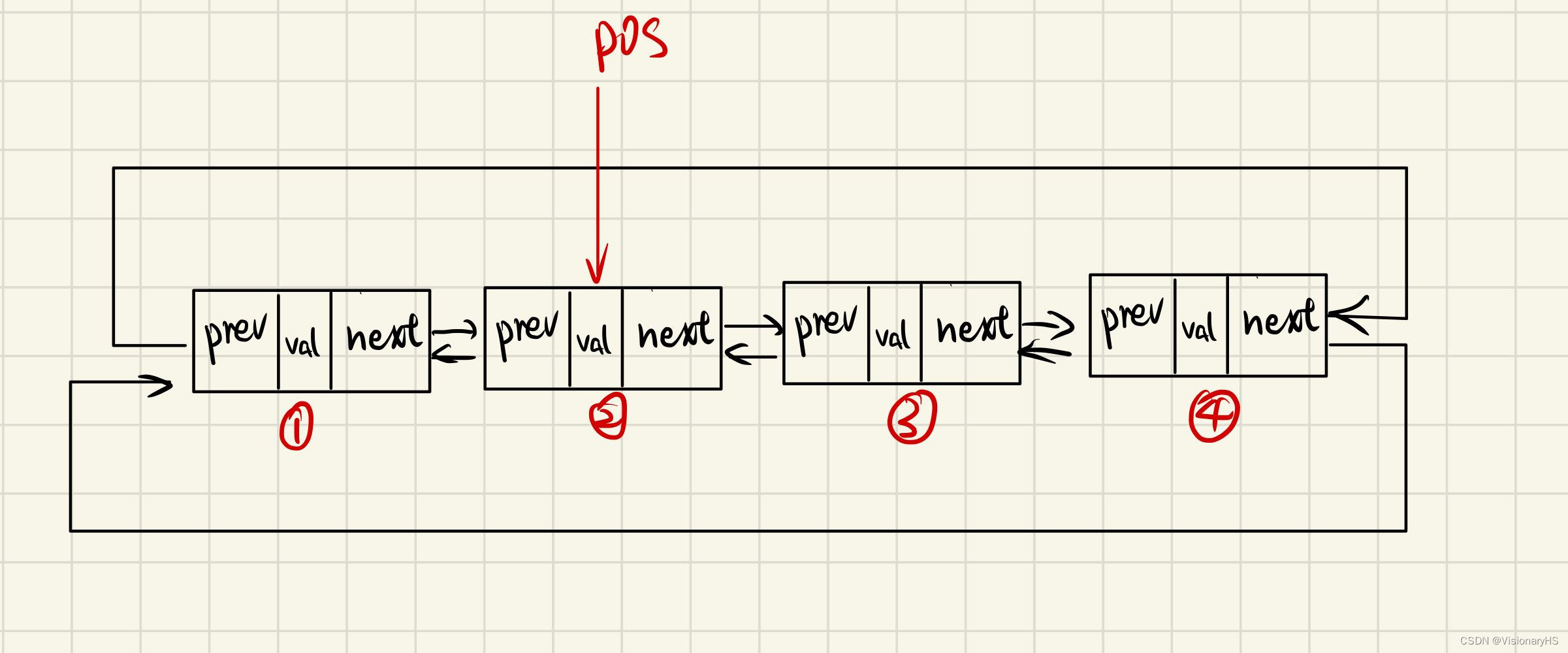
void ListErase(LTNode* pos)
{
	assert(pos);
	LTNode* prev = pos->prev;//记录pos前的数据,方便在posRelink after location data is destroyed
	LTNode* next = pos->next;//记录pos后的数据,方便在posRelink after location data is destroyed
	LTNode* cur = pos;//创建一个curThe new pointer is usedfree空间
	prev->next = next;
	next->prev = prev;
	free(cur);
}
The effect diagram of the function is as follows
7.About the head plug and tail plug,头删尾删
Just plug it inListInsert函数的特殊情况,Insert head and tail;
同理,Just delete the head and tailListErase函数的特殊情况,Delete at the head and tail;
So you can take advantage of these two already existing functions,You only need to pass in the address of the head and tail
void ListPopBack(LTNode* phead)//尾删
{
	assert(phead);
	LTNode* cur = phead->prev;
	ListErase(phead->prev);
	free(cur);
	cur = NULL;
}
void ListPopFront(LTNode* phead)//头删
{
	assert(phead);
	LTNode* cur = phead;
	ListErase(phead);
	free(cur);
	cur = NULL;
}
void ListPushBack(LTNode* phead, LTDataType x)//尾插
{
assert(phead);
ListInsert(phead->prev, x);
}
void ListPushFront(LTNode* phead, LTDataType x)//头插
{
assert(phead);
ListInsert(phead, x);
}8.ListFind查找函数
返回值是指针,If not found, put one backNULL.
LTNode* ListFind(LTNode* phead, LTDataType x)
{
	assert(phead);
	LTNode* cur = phead->next;//将head地址赋给cur,通过cur遍历
	while (cur != phead)
	{
		if (cur->data == x)
			return cur;
		cur = cur->next;
	}//当cur==headWhen it means that the doubly linked list has been traversed once,Not found yet,It means that the given address does not exist in this list
	return NULL;
}
9.ListDestory销毁函数
void ListDestory(LTNode* phead)
{
	assert(phead);
	LTNode* cur = phead->next;//同上,用cur从头遍历
	while (cur != phead)
	{
		LTNode* next = cur->next;//用nextRemember the original next position,Convenient to iterate after destruction
		free(cur);
		cur = next;
	}
	free(phead);//最后把pheadThe memory of the location is freed
}
10.ListPrint打印函数
to the top node,Print in sequence
void ListPrint(LTNode* phead)
{
	assert(phead);
	LTNode* cur = phead->next;
	while (cur!=phead)
	{
		printf("%d<->", cur->data);
		cur = cur->next;
	}
		printf("NULL\n");
}
11.Complete program plus run
LTNode* LTDinit()
{
	LTNode* guard = NULL;
	guard = (LTNode*)malloc(sizeof(LTNode));
	if (guard == NULL)
	{
		perror("malloc fail\n");
		exit;
	}
	else
	{
		guard->next = guard;
		guard->prev = guard;
	}
	return guard;
}
LTNode* BuyListNode(LTDataType x)
{
	LTNode* cur = NULL;
	cur = (LTNode*)malloc(sizeof(LTNode));//mallocBe sure to check afterward
	if (cur == NULL)
	{
		perror("malloc fail\n");
	}
	cur->next = NULL;
	cur->prev = NULL;
	cur->data = x;
	return cur;
}
void ListPrint(LTNode* phead)
{
	assert(phead);
	LTNode* cur = phead->next;
	while (cur!=phead)
	{
		printf("%d<->", cur->data);
		cur = cur->next;
	}
		printf("NULL\n");
}
void ListPushBack(LTNode* phead, LTDataType x)
{
	assert(phead);
	ListInsert(phead->prev, x);

}
void ListPushFront(LTNode* phead, LTDataType x)
{
	assert(phead);
	ListInsert(phead, x);

}
void ListInsert(LTNode* pos, LTDataType x)
{
	assert(pos);
	LTNode* new =BuyListNode(x);
	if (new == NULL)
	{
		perror("malloc fail");
	}
	LTNode* next = pos->next;
	new->next = next;
	new->prev = pos;
	pos->next = new;
	next->prev = new;
}void ListErase(LTNode* pos)
{
	assert(pos);
	LTNode* prev = pos->prev;
	LTNode* next = pos->next;
	LTNode* cur = pos;
	prev->next = next;
	next->prev = prev;
	free(cur);
	cur = NULL;
}
void ListPopBack(LTNode* phead)
{
	assert(phead);
	LTNode* cur = phead->prev;
	ListErase(phead->prev);
	free(cur);
	cur = NULL;
}
void ListPopFront(LTNode* phead)
{
	assert(phead);
	LTNode* cur = phead;
	ListErase(phead);
	free(cur);
	cur = NULL;
}
LTNode* ListFind(LTNode* phead, LTDataType x)
{
	assert(phead);
	LTNode* cur = phead->next;
	while (cur != phead)
	{
		if (cur->data == x)
			return cur;
		cur = cur->next;
	}
	return NULL;
}void ListDestory(LTNode* phead)
{
	assert(phead);
	LTNode* cur = phead->next;
	while (cur != phead)
	{
		LTNode* next = cur->next;
		free(cur);
		cur = next;
	}
	free(phead);
}
头文件如下:
#define _CRT_SECURE_NO_WARNINGS
#include <stdio.h>
#include <assert.h>
#include <stdlib.h>
#include <stdbool.h>
typedef int LTDataType;
typedef struct ListNode
{
	struct ListNode* next;
	struct ListNode* prev;
	LTDataType data;
}LTNode;
LTNode* LTDinit();//初始化双向链表
LTNode* BuyListNode(LTDataType x);//申请新的节点
void ListPrint(LTNode* phead);//打印双向链表
void ListInsert(LTNode* pos, LTDataType x);//在任意位置插入
void ListPushBack(LTNode* phead, LTDataType x);//尾部插入
void ListPushFront(LTNode* phead, LTDataType x);//头部插入
void ListErase(LTNode* pos);//删除数据
void ListPopBack(LTNode* phead);//尾部删除
void ListPopFront(LTNode* phead);//头部删除
LTNode* ListFind(LTNode* phead, LTDataType x);//查找
bool ListEmpty(LTNode* phead);//判断双向链表是否为空
void ListDestory(LTNode* phead);//销毁双向链表
边栏推荐
猜你喜欢

The second bullet of FPGA development: running water lamp experiment

JVM:(五)运行时数据区之虚拟机栈

Transport layer (UDP protocol, TCP protocol three-way handshake, four-way wave)
E-commerce data warehouse notes 1 (data warehouse concept, project requirements and architecture design, data generation module)

详解深拷贝,浅拷贝

地图加载wmts格式底图的配置

左益豪:用代码创造一个新世界|OneFlow U

ABP 6.0.0-rc.1的新特性

HPC技术:MPICH实现原理分析

曾“伪造”Solana七成TVL的“多重人格者”,正望向Aptos
随机推荐
openharmony萌新贡献指南
E-commerce data warehouse notes 1 (data warehouse concept, project requirements and architecture design, data generation module)
递归:理解和应用
力扣:494. 目标和
Web网页端IM产品RainbowChat-Web的v4.1版已发布
力拓信创生态,博睿数据多款产品获得东方通与达梦数据库产品兼容互认证明
3D~RPG游戏的制作
【NPM使用相关】NPM 源设置
Powerful number
redis的原理和源码-事务机制
pip3升级后报错f“pip[sys.version_info.major)“
多路复用技术
网络中的一些基本概念
一文读懂微服务架构的分解设计
The second bullet of FPGA development: running water lamp experiment
重磅直播 | ORB-SLAM3系列代码讲解:关键帧 专题一
rest client: a lightweight vscode plugin for api requests
详解深拷贝,浅拷贝
Database connection pool commons-pool source code analysis
Model fine-tuning transfer learning Finetune method Daquan