当前位置:网站首页>Convolution of images -- [torch learning notes]
Convolution of images -- [torch learning notes]
2022-04-22 18:18:00 【An nlper with poor Chinese】
Convolution of images
Quotation translation :《 Hands-on deep learning 》
Now we have seen how the convolution layer works in theory , We're going to see how this works in practice . Because we motivate it through the applicability of convolutional neural network to image data , We will insist on using image data in our example , And start revisiting the convolution layer we introduced in the previous section . We noticed that , Strictly speaking , Convolution layer is a slight misnomer , Because operations are usually represented as cross associations .
One 、 Cross correlation operation
In the accretion layer , An input array and a related kernel array are combined , Generate an output array through cross correlation operation . Let's see how this works in two-dimensional space . In our case , The input is a height of 3, Width is 3 Two dimensional array of , We mark the shape of the array as 3×3 or (3,3). The height and width of the core array are 2. In the field of deep learning research , Common names for this array include kernel and filter . Kernel window ( Also known as convolution window ) The shape of the core is precisely given by the height and width of the core ( Here is 2×2).
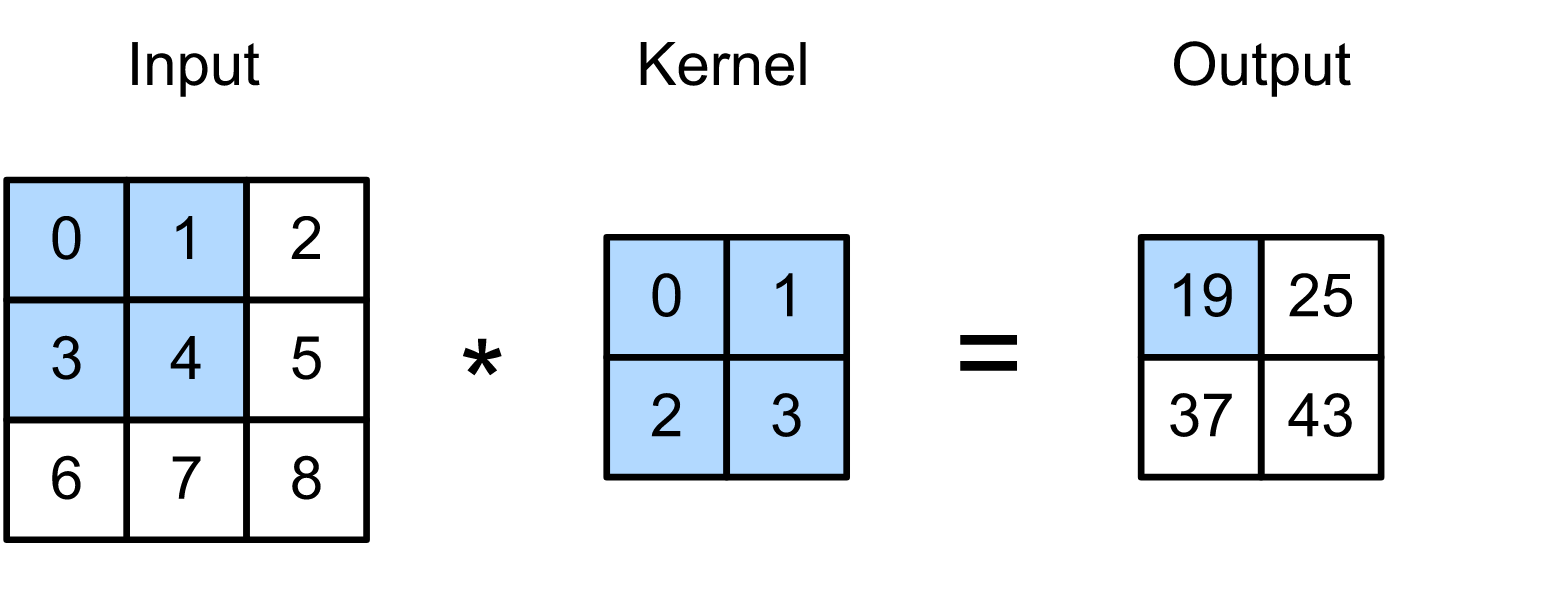
chart : Two dimensional cross correlation operation . The shaded part is the first output element and the input and kernel array elements used for its calculation . 0×0+1×1+3×2+4×3=19 .
In two-dimensional cross-correlation operation , Let's start with the convolution window in the upper left corner of the input array , Then slide on the input array from left to right and from top to bottom . When the convolution window slides to a certain position , The input subarray contained in this window is multiplied by the kernel array ( In terms of elements ), The resulting arrays are added to produce a single scalar value . The result is the value of the output array at the corresponding position . here , The height of the output array is 2, Width is 2, The four elements come from two-dimensional cross-correlation operations .
Please note that , Along each axis , The output is slightly smaller than the input . Because the width of the kernel is larger than 1, Moreover, we can only calculate the cross-correlation of the position where the kernel is completely suitable for the image , The output size is determined by the input size 𝐻×𝑊 Subtract the size of the convolution kernel ℎ×𝑤, namely (𝐻-ℎ+1)×(𝑊-𝑤+1) give . This is because we need enough space on the image " Move " Convolution kernel ( Later we'll see how to keep the size constant by filling zero around the image boundary , So there is enough space to move the core ). Next , We are corr2d Function to implement the above process . It accepts arrays with kernels K Input array of X, And output the array Y.
import torch
from torch import nn

def corr2d(X, K):
    h, w = K.shape  #  The size of the convolution kernel
    print('h,w: ',h,w)
    Y = torch.zeros((X.shape[0] - h + 1, X.shape[1] - w + 1))
    for i in range(Y.shape[0]):
        for j in range(Y.shape[1]):
            Y[i, j] = (X[i: i + h, j: j + w] * K).sum()  #  Add after dot multiplication
    return Y
We can build the input array from the above figure X And kernel array K To verify the output of the implementation of the above two-dimensional cross-correlation operation .
X = torch.Tensor([[0, 1, 2], [3, 4, 5], [6, 7, 8]])
K = torch.Tensor([[0, 1], [2, 3]])
Y = corr2d(X, K)
print('Y: ' ,Y)
h,w:   2 2
 The convolution part   : tensor([[0., 1.],
        [3., 4.]])
 The convolution part   : tensor([[1., 2.],
        [4., 5.]])
 The convolution part   : tensor([[3., 4.],
        [6., 7.]])
 The convolution part   : tensor([[4., 5.],
        [7., 8.]])
Y:  tensor([[19., 25.],
        [37., 43.]])
Two 、 Convolution layer
The convolution layer cross correlates the input and kernel , And add a scalar offset to produce an output . The parameters of the convolution layer are The values that make up the kernel and scalar offsets . When training a convolution based model , We usually initialize the kernel randomly , Just like we do for the full connection layer .
We are now ready to define the above corr2d Function to realize a two-dimensional convolution layer .
stay __init__ In the constructor , We declare that weight and bias are two model parameters . Forward calculation function forward call corr2d Function and add offset . And ℎ×𝑤 Cross correlation , We also call the convolution layer ℎ×𝑤 Convolution .
class Conv2D(nn.Module):
    def __init__(self, kernel_size, **kwargs):
        super(Conv2D, self).__init__(**kwargs)
        #  Pass in kernel_size Convolution kernel size
        self.weight = torch.rand(kernel_size,dtype=torch.float32,requires_grad=True)
        self.bias = torch.zeros((1,),dtype=torch.float32,requires_grad=True)

    def forward(self, x):

        return corr2d(x, self.weight) + self.bias
3、 ... and 、 Object edge detection in image
Let's look at a simple application of convolution : The edge of the object in the image is detected by looking for the position of the pixel change . First , Let's build a 6×8 Pixel “ Images ”. The middle four columns are black (0), The rest is white (1).
X = torch.ones((6, 8))
X[:, 2:6] = 0
X
tensor([[1., 1., 0., 0., 0., 0., 1., 1.],
        [1., 1., 0., 0., 0., 0., 1., 1.],
        [1., 1., 0., 0., 0., 0., 1., 1.],
        [1., 1., 0., 0., 0., 0., 1., 1.],
        [1., 1., 0., 0., 0., 0., 1., 1.],
        [1., 1., 0., 0., 0., 0., 1., 1.]])
Next , We build a high degree of 1、 Width is 2 The kernel of K. When we cross correlate inputs , If the horizontally adjacent elements are the same , The output of 0, otherwise , The output is non-zero .
K = torch.Tensor([[1, -1]])
print('K: ',K)
K: tensor([[ 1., -1.]])
Input X And the kernel we designed K To perform cross-correlation operations . As you can see , We will detect that the edge from white to black is 1, The edge from black to white is -1. The rest of the output is 0.
Y = corr2d(X, K)
print('Y: ',Y)
h,w:   1 2
Y:  tensor([[ 0.,  1.,  0.,  0.,  0., -1.,  0.],
        [ 0.,  1.,  0.,  0.,  0., -1.,  0.],
        [ 0.,  1.,  0.,  0.,  0., -1.,  0.],
        [ 0.,  1.,  0.,  0.,  0., -1.,  0.],
        [ 0.,  1.,  0.,  0.,  0., -1.,  0.],
        [ 0.,  1.,  0.,  0.,  0., -1.,  0.]])
Let's apply the kernel to the transposed image . As expected , It's gone . kernel K Detect only vertical edges .
corr2d(X.t(), K) # take X Transposition , If the horizontally adjacent elements are the same , The output of 0, otherwise , The output is non-zero . So you can't detect
h,w:   1 2

tensor([[0., 0., 0., 0., 0.],
        [0., 0., 0., 0., 0.],
        [0., 0., 0., 0., 0.],
        [0., 0., 0., 0., 0.],
        [0., 0., 0., 0., 0.],
        [0., 0., 0., 0., 0.],
        [0., 0., 0., 0., 0.],
        [0., 0., 0., 0., 0.]])
Transpose at the same time X and K, Then the edge appears :
#  Transpose at the same time X and K, Then the edge appears
corr2d(X.t(), K.t())
h,w:   2 1


tensor([[ 0.,  0.,  0.,  0.,  0.,  0.],
        [ 1.,  1.,  1.,  1.,  1.,  1.],
        [ 0.,  0.,  0.,  0.,  0.,  0.],
        [ 0.,  0.,  0.,  0.,  0.,  0.],
        [ 0.,  0.,  0.,  0.,  0.,  0.],
        [-1., -1., -1., -1., -1., -1.],
        [ 0.,  0.,  0.,  0.,  0.,  0.]])
Four 、 Learn a kernel
If we know this is what we are looking for , So by finite difference [1, -1] To design an edge detector is very good . However , When we see larger nuclei , And considering the continuous convolution layer , It may not be possible to manually specify exactly what each filter should do .
Now let's see if we can just look at ( Input , Output ) To learn from X Generate Y The kernel of . We first build a convolution layer , And initialize its kernel into a random array . Next , In each iteration , We will use the square error to compare Y And the output of the convolution layer , Then calculate the gradient to update the weight . For the sake of simplicity , In this convolution layer , We will ignore the bias .
We built Conv2D class . But here we use Pytorch In the library nn.Conv2D. The custom class we created Conv2D You can use... Similarly .
#  Build a with 1 Convolution layer of two output channels ( The channel will be introduced in the next section ), The shape of the kernel array is (1,2)

conv2d = nn.Conv2d(1,1, kernel_size=(1, 2),bias=False) #  For the sake of simplicity , Ignore bias

#  Two dimensional convolution uses four-dimensional input and output , The format is ( Example channel , Height , Width ), The batch size ( Number of examples in batch ) And the number of channels is 1
X = X.reshape((1, 1, 6, 8))  #  Previous input X
print('X: ',X)

Y = Y.reshape((1, 1, 6, 7))  #  After a corr2d Output Y( As a standard label , To learn convolution kernel parameters )
print('Y: ',Y)

for i in range(10):
    Y_hat = conv2d(X)
    l = (Y_hat - Y) ** 2  #  Defined loss function , Square difference distance
    conv2d.zero_grad()
    l.sum().backward()  #  Back propagation calculation
    #  For the sake of simplicity , We ignore the problem of deviation here
    conv2d.weight.data[:] -= 3e-2 * conv2d.weight.grad  #  Update weights
    if (i + 1) % 2 == 0:
        print('batch %d, loss %.3f' % (i + 1, l.sum()))  #  Output
X:  tensor([[[[1., 1., 0., 0., 0., 0., 1., 1.],
          [1., 1., 0., 0., 0., 0., 1., 1.],
          [1., 1., 0., 0., 0., 0., 1., 1.],
          [1., 1., 0., 0., 0., 0., 1., 1.],
          [1., 1., 0., 0., 0., 0., 1., 1.],
          [1., 1., 0., 0., 0., 0., 1., 1.]]]])
Y:  tensor([[[[ 0.,  1.,  0.,  0.,  0., -1.,  0.],
          [ 0.,  1.,  0.,  0.,  0., -1.,  0.],
          [ 0.,  1.,  0.,  0.,  0., -1.,  0.],
          [ 0.,  1.,  0.,  0.,  0., -1.,  0.],
          [ 0.,  1.,  0.,  0.,  0., -1.,  0.],
          [ 0.,  1.,  0.,  0.,  0., -1.,  0.]]]])
batch 2, loss 3.774
batch 4, loss 0.676
batch 6, loss 0.131
batch 8, loss 0.029
batch 10, loss 0.008
As you can see , stay 10 After iterations , The error has dropped to a very small value . Now let's take a look at what we learned about kernel arrays .
conv2d.weight.data.reshape((1, 2))
tensor([[ 1.0121, -0.9671]])
When considering bias :
#  Constructing a kernel array shape is (1, 2) Two dimensional convolution
conv2d = Conv2D(kernel_size=(1, 2))

step = 20
lr = 0.01
for i in range(step):
    Y_hat = conv2d(X)
    l = ((Y_hat - Y) ** 2).sum()
    l.backward()

    #  gradient descent
    conv2d.weight.data -= lr * conv2d.weight.grad
    conv2d.bias.data -= lr * conv2d.bias.grad

    #  Gradient clear 0
    conv2d.weight.grad.fill_(0)
    conv2d.bias.grad.fill_(0)
    if (i + 1) % 5 == 0:
        print('Step %d, loss %.3f' % (i + 1, l.item()))
h,w:   1 2
h,w:   1 2
h,w:   1 2
h,w:   1 2
h,w:   1 2
Step 5, loss 5.881
h,w:   1 2
h,w:   1 2
h,w:   1 2
h,w:   1 2
h,w:   1 2
Step 10, loss 1.410
h,w:   1 2
h,w:   1 2
h,w:   1 2
h,w:   1 2
h,w:   1 2
Step 15, loss 0.367
h,w:   1 2
h,w:   1 2
h,w:   1 2
h,w:   1 2
h,w:   1 2
Step 20, loss 0.099
#  Output results
print("weight: ", conv2d.weight.data)
print("bias: ", conv2d.bias.data)
weight:  tensor([[ 0.9268, -0.9145]])
bias:  tensor([-0.0069])
in fact , The learned kernel array is different from the kernel array we defined before K Very close to .
5、 ... and 、 Cross correlation and convolution
actually , Convolution is similar to cross-correlation . In order to get the output of convolution , We just flip the core array left and right and up and down , Then do cross-correlation operation with the input array . so , Convolution and cross-correlation are similar , But if they use the same core array , For the same input , The output is often different .
that , You may wonder why convolution can be replaced by cross-correlation in convolution . Actually , In deep learning, kernel arrays are learned : Whether the convolution layer uses cross-correlation operation or convolution operation, it does not affect the output of model prediction . To explain this . In order to be consistent with most in-depth learning literature , If there is no special instruction , The convolution operation mentioned in this book refers to cross-correlation operation .
6、 ... and 、 summary
The core calculation of two-dimensional convolution is a two-dimensional cross-correlation operation . In its simplest form , It performs cross-correlation operation between two-dimensional input data and kernel , Then add an offset .
We can design a kernel to detect the edge in the image .
We can learn the kernel from the data .
7、 ... and 、 practice
1、 Build an image with diagonal edges X.
- If you apply the kernel to it K, What's going to happen ?
- If you will X Transposition , What's going to happen ?
- If you transpose K What's going to happen ?
① Constructing diagonal image matrix
#  Constructing diagonal image matrix
Z = torch.ones((8, 8))
for i in range(len(Z)):
    Z[i, i] = 0
print('Z:',Z)
Z: tensor([[0., 1., 1., 1., 1., 1., 1., 1.],
        [1., 0., 1., 1., 1., 1., 1., 1.],
        [1., 1., 0., 1., 1., 1., 1., 1.],
        [1., 1., 1., 0., 1., 1., 1., 1.],
        [1., 1., 1., 1., 0., 1., 1., 1.],
        [1., 1., 1., 1., 1., 0., 1., 1.],
        [1., 1., 1., 1., 1., 1., 0., 1.],
        [1., 1., 1., 1., 1., 1., 1., 0.]])
② Apply convolution kernel K To deal with Z
#  Apply convolution kernel K To deal with Z
corr2d(Z, K)
h,w:   1 2

tensor([[-1.,  0.,  0.,  0.,  0.,  0.,  0.],
        [ 1., -1.,  0.,  0.,  0.,  0.,  0.],
        [ 0.,  1., -1.,  0.,  0.,  0.,  0.],
        [ 0.,  0.,  1., -1.,  0.,  0.,  0.],
        [ 0.,  0.,  0.,  1., -1.,  0.,  0.],
        [ 0.,  0.,  0.,  0.,  1., -1.,  0.],
        [ 0.,  0.,  0.,  0.,  0.,  1., -1.],
        [ 0.,  0.,  0.,  0.,  0.,  0.,  1.]])
③ If you will Z Transposition , What's going to happen
#  If you will Z Transposition , What's going to happen
corr2d(Z.t(), K)
#  unchanged
h,w: 1 2
Output :
tensor([[-1.,  0.,  0.,  0.,  0.,  0.,  0.],
        [ 1., -1.,  0.,  0.,  0.,  0.,  0.],
        [ 0.,  1., -1.,  0.,  0.,  0.,  0.],
        [ 0.,  0.,  1., -1.,  0.,  0.,  0.],
        [ 0.,  0.,  0.,  1., -1.,  0.,  0.],
        [ 0.,  0.,  0.,  0.,  1., -1.,  0.],
        [ 0.,  0.,  0.,  0.,  0.,  1., -1.],
        [ 0.,  0.,  0.,  0.,  0.,  0.,  1.]])
④ Transposition K What's going to happen ?
#  If you transpose K What's going to happen ?
corr2d(Z, K.t())

#  The secondary diagonal will change above
h,w:   2 1

tensor([[-1.,  1.,  0.,  0.,  0.,  0.,  0.,  0.],
        [ 0., -1.,  1.,  0.,  0.,  0.,  0.,  0.],
        [ 0.,  0., -1.,  1.,  0.,  0.,  0.,  0.],
        [ 0.,  0.,  0., -1.,  1.,  0.,  0.,  0.],
        [ 0.,  0.,  0.,  0., -1.,  1.,  0.,  0.],
        [ 0.,  0.,  0.,  0.,  0., -1.,  1.,  0.],
        [ 0.,  0.,  0.,  0.,  0.,  0., -1.,  1.]])
2、 How do you change the input and kernel array to represent a cross-correlation operation, matrix multiplication ?
Why should convolution be transformed into matrix multiplication ?
To speed up the operation , The traditional calculation method of convolution kernel sliding in turn is difficult to accelerate .
After converting to matrix multiplication , You can call various linear algebra operation Libraries ,CUDA Inside the matrix multiplication implementation . These matrix multiplications are limit optimized , Many times faster than violent calculation .
3、 Manually design some kernels .
- What is the form of the kernel of the second derivative ?
- What is the kernel of Laplacian ?
- What is the kernel of integral ?
- In order to get a degree of 𝑑 The derivative of , What is the minimum size of the kernel ?
版权声明
本文为[An nlper with poor Chinese]所创,转载请带上原文链接,感谢
https://yzsam.com/2022/04/202204221812394329.html
边栏推荐
猜你喜欢

还弄不懂相对路径和绝对路径,这篇文章带你简单剖析

golang-gin-websocket问题

Why don't I use flomo anymore

【思考与进步】:关于自己的遗憾

在 Kubernetes 集群中部署现代应用的通用模式

Hackmyvm (XXV) helium, series of articles continuously updated

es6 Generator函数的使用

208. 实现 Trie (前缀树)

构建中国云生态 | 华云数据与百信完成产品兼容互认证 携手推动信创产业高质量发展

18730 coloring problem (two ways of writing fast power)
随机推荐
知乎热议:浙大读博八年现靠送外卖赚钱
秒雲助力中電科32所發布“基於擬態應用集成框架的SaaS雲管理平臺解决方案”
图像的卷积——【torch学习笔记】
[fundamentals of interface testing] Chapter 10 | explain the pre script of postman request and its working principle in detail
Recent learning experience
C语言读写txt文件
多次调用 BAPI 之后,最后一次性 COMMIT WORK,会有什么问题吗?
Dpdk obtains and parses packets from ring queue and uses hashtable statistics
208. Implement trie (prefix tree)
小程序----API
Esprima ECMAScript parsing architecture
旅游产品分析:要出发周边游
18730 coloring problem (two ways of writing fast power)
Deleted items can be recovered even after the outlook Deleted Items folder is empty
国产芯片DP9637-K总线收发器替代L9637D芯片和SI9241
关于.net core 中使用ActionFilter 以及ActionFilter的自动事务
C# 从list 或者string中随机获取一个
Use of ES6 generator function
电脑硬件中最重要的部分是什么?
数字化靶场的未来方向