当前位置:网站首页>The use of pytorch: temperature prediction using neural networks
The use of pytorch: temperature prediction using neural networks
2022-08-05 00:59:00 【The romance of cherry blossoms】
1.首先,Let's take a look at what's going on with the data


数据表中
- year,moth,day,week分别表示的具体的时间
- temp_2:前天的最高温度值
- temp_1:昨天的最高温度值
- average:在历史中,每年这一天的平均最高温度值
- actual:这就是我们的标签值了,当天的真实最高温度
- friend:这一列可能是凑热闹的,你的朋友猜测的可能值,whatever it is
Year, month and day are all characteristics of time,We convert it to time type data,To facilitate our drawing display
# 处理时间数据
import datetime

# 分别得到年,月,日
years = features['year']
months = features['month']
days = features['day']

# datetime格式
dates = [str(int(year)) + '-' + str(int(month)) + '-' + str(int(day)) for year, month, day in zip(years, months, days)]
dates = [datetime.datetime.strptime(date, '%Y-%m-%d') for date in dates]
We then use the graph to visually display the data:
# 准备画图
# 指定默认风格
plt.style.use('fivethirtyeight')

# 设置布局
fig, ((ax1, ax2), (ax3, ax4)) = plt.subplots(nrows=2, ncols=2, figsize = (10,10))
fig.autofmt_xdate(rotation = 45)

# 标签值
ax1.plot(dates, features['actual'])
ax1.set_xlabel(''); ax1.set_ylabel('Temperature'); ax1.set_title('Max Temp')

# 昨天
ax2.plot(dates, features['temp_1'])
ax2.set_xlabel(''); ax2.set_ylabel('Temperature'); ax2.set_title('Previous Max Temp')

# 前天
ax3.plot(dates, features['temp_2'])
ax3.set_xlabel('Date'); ax3.set_ylabel('Temperature'); ax3.set_title('Two Days Prior Max Temp')

# 我的逗逼朋友
ax4.plot(dates, features['friend'])
ax4.set_xlabel('Date'); ax4.set_ylabel('Temperature'); ax4.set_title('Friend Estimate')

plt.tight_layout(pad=2) 
Convert text data to one-hot encoding:

Remove the label column from the feature:
# 标签
labels = np.array(features['actual'])

# 在特征中去掉标签
features= features.drop('actual', axis = 1)

# 名字单独保存一下,以备后患
feature_list = list(features.columns)

# 转换成合适的格式
features = np.array(features)
对数据进行标准化处理:

2.构建网络模型
包括:权重参数初始化、计算隐层、加入激活函数、预测结果、计算损失、返向传播计算、更新参数.另外,Remember to clear the gradient every iteration,否则梯度会累加
x = torch.tensor(input_features, dtype = float)

y = torch.tensor(labels, dtype = float)

# 权重参数初始化
weights = torch.randn((14, 128), dtype = float, requires_grad = True)
biases = torch.randn(128, dtype = float, requires_grad = True)
weights2 = torch.randn((128, 1), dtype = float, requires_grad = True)
biases2 = torch.randn(1, dtype = float, requires_grad = True)

learning_rate = 0.001
losses = []

for i in range(1000):
    # 计算隐层
    hidden = x.mm(weights) + biases
    # 加入激活函数
    hidden = torch.relu(hidden)
    # 预测结果
    predictions = hidden.mm(weights2) + biases2
    # 通计算损失
    loss = torch.mean((predictions - y) ** 2)
    losses.append(loss.data.numpy())

    # 打印损失值
    if i % 100 == 0:
        print('loss:', loss)
    #返向传播计算
    loss.backward()

    #更新参数
    weights.data.add_(- learning_rate * weights.grad.data)
    biases.data.add_(- learning_rate * biases.grad.data)
    weights2.data.add_(- learning_rate * weights2.grad.data)
    biases2.data.add_(- learning_rate * biases2.grad.data)

    # 每次迭代都得记得清空
    weights.grad.data.zero_()
    biases.grad.data.zero_()
    weights2.grad.data.zero_()
    biases2.grad.data.zero_()

3.Simpler network model
直接使用nn.Model
input_size = input_features.shape[1]
hidden_size = 128
output_size = 1
batch_size = 16
my_nn = torch.nn.Sequential(
    torch.nn.Linear(input_size, hidden_size),
    torch.nn.Sigmoid(),
    torch.nn.Linear(hidden_size, output_size),
)
cost = torch.nn.MSELoss(reduction='mean')
optimizer = torch.optim.Adam(my_nn.parameters(), lr = 0.001)
训练网络:
# 训练网络
losses = []
for i in range(1000):
    batch_loss = []
    # MINI-Batch方法来进行训练
    for start in range(0, len(input_features), batch_size):
        end = start + batch_size if start + batch_size < len(input_features) else len(input_features)
        xx = torch.tensor(input_features[start:end], dtype = torch.float, requires_grad = True)
        yy = torch.tensor(labels[start:end], dtype = torch.float, requires_grad = True)
        prediction = my_nn(xx)
        loss = cost(prediction, yy)
        optimizer.zero_grad()
        loss.backward(retain_graph=True)
        optimizer.step()
        batch_loss.append(loss.data.numpy())

    # 打印损失
    if i % 100==0:
        losses.append(np.mean(batch_loss))
        print(i, np.mean(batch_loss))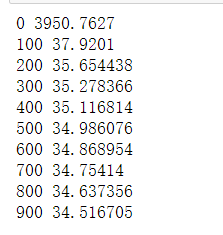
4.预训练结果
x = torch.tensor(input_features, dtype = torch.float)
predict = my_nn(x).data.numpy()
转换日期格式
dates = [str(int(year)) + '-' + str(int(month)) + '-' + str(int(day)) for year, month, day in zip(years, months, days)]
dates = [datetime.datetime.strptime(date, '%Y-%m-%d') for date in dates]
# 创建一个表格来存日期和其对应的标签数值
true_data = pd.DataFrame(data = {'date': dates, 'actual': labels})
# 同理,再创建一个来存日期和其对应的模型预测值
months = features[:, feature_list.index('month')]
days = features[:, feature_list.index('day')]
years = features[:, feature_list.index('year')]
test_dates = [str(int(year)) + '-' + str(int(month)) + '-' + str(int(day)) for year, month, day in zip(years, months, days)]
test_dates = [datetime.datetime.strptime(date, '%Y-%m-%d') for date in test_dates]
predictions_data = pd.DataFrame(data = {'date': test_dates, 'prediction': predict.reshape(-1)}) # 真实值
plt.plot(true_data['date'], true_data['actual'], 'b-', label = 'actual')
# 预测值
plt.plot(predictions_data['date'], predictions_data['prediction'], 'ro', label = 'prediction')
plt.xticks(rotation = '60');
plt.legend()
# 图名
plt.xlabel('Date'); plt.ylabel('Maximum Temperature (F)'); plt.title('Actual and Predicted Values');

边栏推荐
- After the staged testing is complete, have you performed defect analysis?
- Binary tree [full solution] (C language)
- 硬实力和软实力,哪个对测试人来说更重要?
- Software Testing Interview Questions: What Are the Types of Software Testing?
- 软件测试技术之最有效的七大性能测试技术
- Countdown to 1 day!From August 2nd to 4th, I will talk with you about open source and employment!
- Theory of Software Fundamentals
- 蓝牙Mesh系统开发五 ble mesh设备增加与移除
- GCC: paths to header and library files
- MBps与Mbps区别
猜你喜欢


![Binary tree [full solution] (C language)](/img/4d/2d81dc75433c23c5ba6b31453396f0.png)


随机推荐
第十四天&postman
Software Testing Interview Questions: What do you think about software process improvement? Is there something that needs improvement in the enterprise you have worked for? What do you expect the idea
canvas Gaussian blur effect
LiveVideoStackCon 2022 Shanghai Station opens tomorrow!
动态规划/背包问题总结/小结——01背包、完全背包
习题:选择结构(一)
金九银十面试跳槽季;你准备好了吗?
软件测试技术之最有效的七大性能测试技术
【FreeRTOS】FreeRTOS与stm32内置堆栈的占用情况
2022 Nioke Multi-School Training Session H Question H Take the Elevator
pytorch的使用:使用神经网络进行气温预测
Helm Chart
MongoDB搭建及基础操作
tcp中的三次握手与四次挥手
Software testing interview questions: What are the strategies for system testing?
Pytorch usage and tricks
pytorch的使用:卷积神经网络模块
gorm joint table query - actual combat
如何用 Solidity 创建一个“Hello World”智能合约
Pytorch使用和技巧