Pytorch implementation of MixNMatch

Overview

MixNMatch: Multifactor Disentanglement and Encoding for Conditional Image Generation
[Paper]

Yuheng Li, Krishna Kumar Singh, Utkarsh Ojha, Yong Jae Lee
UC Davis
In CVPR, 2020

1/31/2020 update: Code and models released.

Demo Video
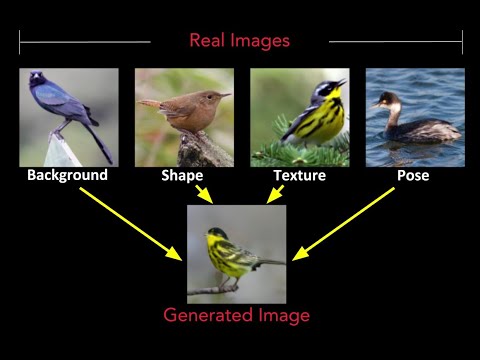
IMAGE ALT TEXT HERE

This is our CVPR2020 presentation video link

Web Demo

For interactive web demo click here. This web demo is created by Yang Xue.

Requirements

  • Linux
  • Python 3.7
  • Pytorch 1.3.1
  • NVIDIA GPU + CUDA CuDNN

Getting started

Clone the repository

git clone https://github.com/Yuheng-Li/MixNMatch.git
cd MixNMatch

Setting up the data

Download the formatted CUB data from this link and extract it inside the data directory

Downloading pretrained models

Pretrained models for CUB, Dogs and Cars are available at this link. Download and extract them in the models directory.

Evaluating the model

In code

  • Run python eval.py --z path_to_pose_source_images --b path_to_bg_source_images --p path_to_shape_source_images --c path_to_color_source_images --out path_to_ourput --mode code_or_feature --models path_to_pretrained_models
  • For example python eval.py --z pose/pose-1.png --b background/background-1.png --p shape/shape-1.png --c color/color.png --mode code --models ../models --out ./code-1.png
    • NOTE:(1) in feature mode pose source images will be ignored; (2) Generator, Encoder and Feature_extractor in models folder should be named as G.pth, E.pth and EX.pth

Training your own model

In code/config.py:

  • Specify the dataset location in DATA_DIR.
    • NOTE: If you wish to train this on your own (different) dataset, please make sure it is formatted in a way similar to the CUB dataset that we've provided.
  • Specify the number of super and fine-grained categories that you wish for FineGAN to discover, in SUPER_CATEGORIES and FINE_GRAINED_CATEGORIES.
  • For the first stage training run python train_first_stage.py output_name
  • For the second stage training run python train_second_stage.py output_name path_to_pretrained_G path_to_pretrained_E
    • NOTE: output will be in output/output_name
    • NOTE: path_to_pretrained_G will be output/output_name/Model/G_0.pth
    • NOTE: path_to_pretrained_E will be output/output_name/Model/E_0.pth
  • For example python train_second_stage.py Second_stage ../output/output_name/Model/G_0.pth ../output/output_name/Model/E_0.pth

Results

1. Extracting all factors from differnet real images to synthesize a new image


2. Comparison between the feature and code mode


3. Manipulating real images by varying a single factor


4. Inferring style from unseen data

Cartoon -> image Sketch -> image

5. Converting a reference image according to a reference video


Citation

If you find this useful in your research, consider citing our work:

@inproceedings{li-cvpr2020,
  title = {MixNMatch: Multifactor Disentanglement and Encoding for Conditional Image Generation},
  author = {Yuheng Li and Krishna Kumar Singh and Utkarsh Ojha and Yong Jae Lee},
  booktitle = {CVPR},
  year = {2020}
}
Auditing Black-Box Prediction Models for Data Minimization Compliance

Data-Minimization-Auditor An auditing tool for model-instability based data minimization that is introduced in "Auditing Black-Box Prediction Models f

Bashir Rastegarpanah 2 Mar 24, 2022
Negative Sample Matters: A Renaissance of Metric Learning for Temporal Grounding

2D-TAN (Optimized) Introduction This is an optimized re-implementation repository for AAAI'2020 paper: Learning 2D Temporal Localization Networks for

Joya Chen 112 Dec 31, 2022
Torchlight2 lan game server tool - A message forwarding tool for Torchlight 2 lan game

Torchlight 2 Lan Game Server Tool A message forwarding tool for Torchlight 2 lan

Huaijun Jiang 3 Nov 01, 2022
Spontaneous Facial Micro Expression Recognition using 3D Spatio-Temporal Convolutional Neural Networks

Spontaneous Facial Micro Expression Recognition using 3D Spatio-Temporal Convolutional Neural Networks Abstract Facial expression recognition in video

Bogireddy Sai Prasanna Teja Reddy 103 Dec 29, 2022
PyTorch implementation of Octave Convolution with pre-trained Oct-ResNet and Oct-MobileNet models

octconv.pytorch PyTorch implementation of Octave Convolution in Drop an Octave: Reducing Spatial Redundancy in Convolutional Neural Networks with Octa

Duo Li 273 Dec 18, 2022
Training code and evaluation benchmarks for the "Self-Supervised Policy Adaptation during Deployment" paper.

Self-Supervised Policy Adaptation during Deployment PyTorch implementation of PAD and evaluation benchmarks from Self-Supervised Policy Adaptation dur

Nicklas Hansen 101 Nov 01, 2022
Generative Flow Networks for Discrete Probabilistic Modeling

Energy-based GFlowNets Code for Generative Flow Networks for Discrete Probabilistic Modeling by Dinghuai Zhang, Nikolay Malkin, Zhen Liu, Alexandra Vo

Narsil-Dinghuai Zhang 51 Dec 20, 2022
Unofficial PyTorch Implementation of "DOLG: Single-Stage Image Retrieval with Deep Orthogonal Fusion of Local and Global Features"

Pytorch Implementation of Deep Orthogonal Fusion of Local and Global Features (DOLG) This is the unofficial PyTorch Implementation of "DOLG: Single-St

DK 96 Jan 06, 2023
Implementation for Learning to Track with Object Permanence

Learning to Track with Object Permanence A video-based MOT approach capable of tracking through full occlusions: Learning to Track with Object Permane

Toyota Research Institute - Machine Learning 91 Jan 03, 2023
GemNet model in PyTorch, as proposed in "GemNet: Universal Directional Graph Neural Networks for Molecules" (NeurIPS 2021)

GemNet: Universal Directional Graph Neural Networks for Molecules Reference implementation in PyTorch of the geometric message passing neural network

Data Analytics and Machine Learning Group 124 Dec 30, 2022
The source codes for TME-BNA: Temporal Motif-Preserving Network Embedding with Bicomponent Neighbor Aggregation.

TME The source codes for TME-BNA: Temporal Motif-Preserving Network Embedding with Bicomponent Neighbor Aggregation. Our implementation is based on TG

2 Feb 10, 2022
MPViT:Multi-Path Vision Transformer for Dense Prediction

MPViT : Multi-Path Vision Transformer for Dense Prediction This repository inlcu

Youngwan Lee 272 Dec 20, 2022
This is the repo for the paper "Improving the Accuracy-Memory Trade-Off of Random Forests Via Leaf-Refinement".

Improving the Accuracy-Memory Trade-Off of Random Forests Via Leaf-Refinement This is the repository for the paper "Improving the Accuracy-Memory Trad

3 Dec 29, 2022
Intro-to-dl - Resources for "Introduction to Deep Learning" course.

Introduction to Deep Learning course resources https://www.coursera.org/learn/intro-to-deep-learning Running on Google Colab (tested for all weeks) Go

Advanced Machine Learning specialisation by HSE 761 Dec 24, 2022
HuSpaCy: industrial-strength Hungarian natural language processing

HuSpaCy: Industrial-strength Hungarian NLP HuSpaCy is a spaCy model and a library providing industrial-strength Hungarian language processing faciliti

HuSpaCy 120 Dec 14, 2022
DeepVoxels is an object-specific, persistent 3D feature embedding.

DeepVoxels is an object-specific, persistent 3D feature embedding. It is found by globally optimizing over all available 2D observations of

Vincent Sitzmann 196 Dec 25, 2022
Open source implementation of "A Self-Supervised Descriptor for Image Copy Detection" (SSCD).

A Self-Supervised Descriptor for Image Copy Detection (SSCD) This is the open-source codebase for "A Self-Supervised Descriptor for Image Copy Detecti

Meta Research 68 Jan 04, 2023
Implicit MLE: Backpropagating Through Discrete Exponential Family Distributions

torch-imle Concise and self-contained PyTorch library implementing the I-MLE gradient estimator proposed in our NeurIPS 2021 paper Implicit MLE: Backp

UCL Natural Language Processing 249 Jan 03, 2023
Instance-wise Feature Importance in Time (FIT)

Instance-wise Feature Importance in Time (FIT) FIT is a framework for explaining time series perdiction models, by assigning feature importance to eve

Sana 46 Dec 25, 2022
Hypersearch weight debugging and losses tutorial

tutorial Activate tensorboard option Running TensorBoard remotely When working on a remote server, you can use SSH tunneling to forward the port of th

1 Dec 11, 2021