
Leibniz is a python package which provide facilities to express learnable partial differential equations with PyTorch

Overview

Leibniz

DOI Build Status

Leibniz is a python package which provide facilities to express learnable differential equations with PyTorch

We also provide UNet, ResUNet and their variations, especially the Hyperbolic blocks for ResUNet.

Install

pip install leibniz

How to use

Physics-informed

As an example we solve a very simple advection problem, a box-shaped material transported by a constant steady wind.
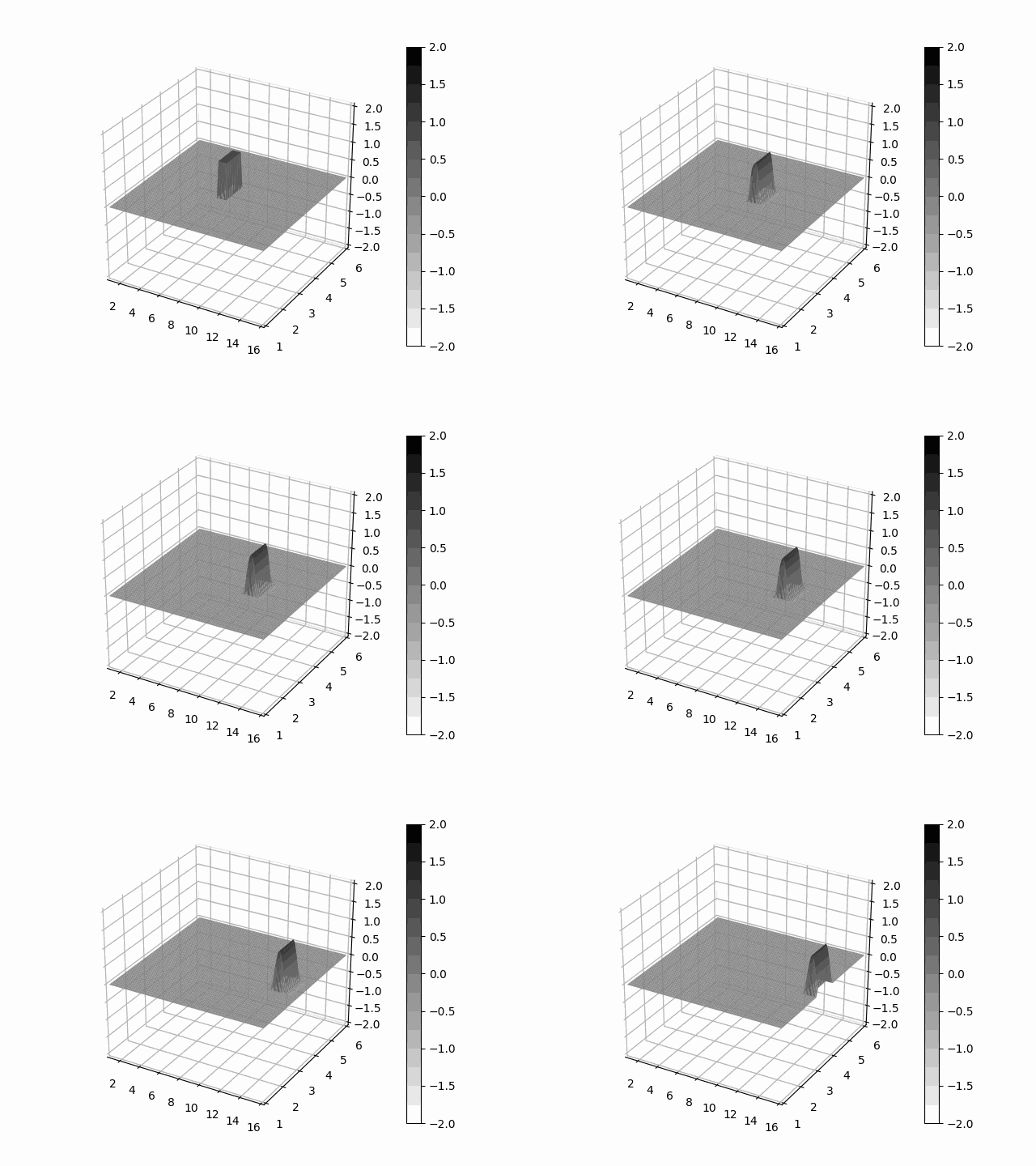
moving box

import torch as th
import leibniz as lbnz

from leibniz.core3d.gridsys.regular3 import RegularGrid
from leibniz.diffeq import odeint as odeint


def binary(tensor):
    return th.where(tensor > lbnz.zero, lbnz.one, lbnz.zero)

# setup grid system
lbnz.bind(RegularGrid(
    basis='x,y,z',
    W=51, L=151, H=51,
    east=16.0, west=1.0,
    north=6.0, south=1.0,
    upper=6.0, lower=1.0
))
lbnz.use('x,y,z') # use xyz coordinate

# giving a material field as a box 
fld = binary((lbnz.x - 8) * (9 - lbnz.x)) * \
      binary((lbnz.y - 3) * (4 - lbnz.y)) * \
      binary((lbnz.z - 3) * (4 - lbnz.z))

# construct a constant steady wind
wind = lbnz.one, lbnz.zero, lbnz.zero

# transport value by wind
def derivitive(t, clouds):
    return - lbnz.upwind(wind, clouds)

# integrate the system with rk4
pred = odeint(derivitive, fld, th.arange(0, 7, 1 / 100), method='rk4')

UNet, ResUNet and variations

from leibniz.unet import UNet
from leibniz.nn.layer.hyperbolic import HyperBottleneck
from leibniz.nn.activation import CappingRelu

unet = UNet(6, 1, normalizor='batch', spatial=(32, 64), layers=5, ratio=-1,
            vblks=[4, 4, 4, 4, 4], hblks=[1, 1, 1, 1, 1],
            scales=[-1, -1, -1, -1, -1], factors=[1, 1, 1, 1, 1],
            block=HyperBottleneck, relu=CappingRelu(), final_normalized=False)

We provide a ResUNet implementation, which is a UNet variation can insert ResNet blocks between layers. The supported ResNet blocks are include

  • Pure ResNet: Basic, Bottleneck block
  • SENet variations: Basic, Bottleneck block
  • Hyperbolic variations: Basic, Bottleneck block

We support 1d, 2d, 3d UNet.

normalizor are include:

  • batch: BatchNorm
  • layer: LayerNorm
  • instance: InstanceNorm

Other hyperparameters are include:

  • spatial: the sizes of the spatial dimentions
  • ratio: the ratio to decide the intial number of channels into the UNet
  • vblks: how many vertical blocks is inserted between two layers
  • hblks: how many horizontal blocks is inserted in the skip connections
  • scales: scale factors(power-2-based) on the spatial dimentions
  • factors: expand or shrink factors(power-2-based) on the channels
  • final_normalized: wheather to scale to final result between 0 to 1

Piecewise Linear normalizor

Piecewise Linear normalizor provide an learnable monotonic peicewise linear functions and its inverse fucntion. The API is shown as below

from leibniz.nn.normalizor import PWLNormalizor

# on 3 channels, given 128 segmented pieces, and assuming the input data have a zero mean and 1.0 std
pwln = PWLNormalizor(3, 128, mean=0.0, std=1.0)

normed = pwln(input)
output = pwln.inverse(normed)

How to release

python3 setup.py sdist bdist_wheel
python3 -m twine upload dist/*

git tag va.b.c master
git push origin va.b.c

Contributors

Acknowledge

We included source code with minor changes from torchdiffeq by Ricky Chen, because of two purpose:

  1. package torchdiffeq is not indexed by pypi
  2. package torchdiffeq is very convenient and mandatory

All our contribution is based on Ricky's Neural ODE paper (NIPS 2018) and his package.

You might also like...
Learnable Multi-level Frequency Decomposition and Hierarchical Attention Mechanism for Generalized Face Presentation Attack Detection

LMFD-PAD Note This is the official repository of the paper: LMFD-PAD: Learnable Multi-level Frequency Decomposition and Hierarchical Attention Mechani

A Planar RGB-D SLAM which utilizes Manhattan World structure to provide optimal camera pose trajectory while also providing a sparse reconstruction containing points, lines and planes, and a dense surfel-based reconstruction.

ManhattanSLAM Authors: Raza Yunus, Yanyan Li and Federico Tombari ManhattanSLAM is a real-time SLAM library for RGB-D cameras that computes the camera

Implementation of "Scaled-YOLOv4: Scaling Cross Stage Partial Network" using PyTorch framwork.

YOLOv4-large This is the implementation of "Scaled-YOLOv4: Scaling Cross Stage Partial Network" using PyTorch framwork. YOLOv4-CSP YOLOv4-tiny YOLOv4-

Unofficial pytorch implementation of 'Image Inpainting for Irregular Holes Using Partial Convolutions'

pytorch-inpainting-with-partial-conv Official implementation is released by the authors. Note that this is an ongoing re-implementation and I cannot f

Reproduce partial features of DeePMD-kit using PyTorch.

DeePMD-kit on PyTorch For better understand DeePMD-kit, we implement its partial features using PyTorch and expose interface consuing descriptors. Tec

A PyTorch implementation of ICLR 2022 Oral paper PiCO: Contrastive Label Disambiguation for Partial Label Learning

PiCO: Contrastive Label Disambiguation for Partial Label Learning This is a PyTorch implementation of ICLR 2022 Oral paper PiCO; also see our Project

A Python framework for developing parallelized Computational Fluid Dynamics software to solve the hyperbolic 2D Euler equations on distributed, multi-block structured grids.

pyHype: Computational Fluid Dynamics in Python pyHype is a Python framework for developing parallelized Computational Fluid Dynamics software to solve

Using NumPy to solve the equations of fluid mechanics together with Finite Differences, explicit time stepping and Chorin's Projection methods

Computational Fluid Dynamics in Python Using NumPy to solve the equations of fluid mechanics 🌊 🌊 🌊 together with Finite Differences, explicit time

Genetic Algorithm, Particle Swarm Optimization, Simulated Annealing, Ant Colony Optimization Algorithm,Immune Algorithm, Artificial Fish Swarm Algorithm, Differential Evolution and TSP(Traveling salesman)

scikit-opt Swarm Intelligence in Python (Genetic Algorithm, Particle Swarm Optimization, Simulated Annealing, Ant Colony Algorithm, Immune Algorithm,A

Releases(v0.1.42)
  • v0.1.42(Aug 14, 2021)

  • v0.1.41(Aug 13, 2021)

    Leibniz is a python package which provide facilities to express learnable differential equations with PyTorch. We also provide UNet, ResUNet and their variations, especially the Hyperbolic blocks for ResUNet.

    Source code(tar.gz)
    Source code(zip)
Owner
Beijing ColorfulClouds Technology Co.,Ltd.
彩云科技
Beijing ColorfulClouds Technology Co.,Ltd.
A collection of 100 Deep Learning images and visualizations

A collection of Deep Learning images and visualizations. The project has been developed by the AI Summer team and currently contains almost 100 images.

AI Summer 65 Sep 12, 2022
The project of phase's key role in complex and real NN

Phase-in-NN This is the code for our project at Princeton (co-authors: Yuqi Nie, Hui Yuan). The paper title is: "Neural Network is heterogeneous: Phas

YuqiNie-lab 1 Nov 04, 2021
This is a clean and robust Pytorch implementation of DQN and Double DQN.

DQN/DDQN-Pytorch This is a clean and robust Pytorch implementation of DQN and Double DQN. Here is the training curve: All the experiments are trained

XinJingHao 15 Dec 27, 2022
A Pytorch Implementation of Domain adaptation of object detector using scissor-like networks

A Pytorch Implementation of Domain adaptation of object detector using scissor-like networks Please follow Faster R-CNN and DAF to complete the enviro

2 Oct 07, 2022
A PyTorch implementation of "Multi-Scale Contrastive Siamese Networks for Self-Supervised Graph Representation Learning", IJCAI-21

MERIT A PyTorch implementation of our IJCAI-21 paper Multi-Scale Contrastive Siamese Networks for Self-Supervised Graph Representation Learning. Depen

Graph Analysis & Deep Learning Laboratory, GRAND 32 Jan 02, 2023
Deep Reinforcement Learning for mobile robot navigation in ROS Gazebo simulator

DRL-robot-navigation Deep Reinforcement Learning for mobile robot navigation in ROS Gazebo simulator. Using Twin Delayed Deep Deterministic Policy Gra

87 Jan 07, 2023
Official PyTorch implementation of the paper: DeepSIM: Image Shape Manipulation from a Single Augmented Training Sample

DeepSIM: Image Shape Manipulation from a Single Augmented Training Sample (ICCV 2021 Oral) Project | Paper Official PyTorch implementation of the pape

Eliahu Horwitz 393 Dec 22, 2022
Official implement of Evo-ViT: Slow-Fast Token Evolution for Dynamic Vision Transformer

Evo-ViT: Slow-Fast Token Evolution for Dynamic Vision Transformer This repository contains the PyTorch code for Evo-ViT. This work proposes a slow-fas

YifanXu 53 Dec 05, 2022
Learning to Simulate Dynamic Environments with GameGAN (CVPR 2020)

Learning to Simulate Dynamic Environments with GameGAN PyTorch code for GameGAN Learning to Simulate Dynamic Environments with GameGAN Seung Wook Kim,

199 Dec 26, 2022
Official page of Struct-MDC (RA-L'22 with IROS'22 option); Depth completion from Visual-SLAM using point & line features

Struct-MDC (click the above buttons for redirection!) Official page of "Struct-MDC: Mesh-Refined Unsupervised Depth Completion Leveraging Structural R

Urban Robotics Lab. @ KAIST 37 Dec 22, 2022
Open source implementation of "A Self-Supervised Descriptor for Image Copy Detection" (SSCD).

A Self-Supervised Descriptor for Image Copy Detection (SSCD) This is the open-source codebase for "A Self-Supervised Descriptor for Image Copy Detecti

Meta Research 68 Jan 04, 2023
A project which aims to protect your privacy using inexpensive hardware and easily modifiable software

Protecting your privacy using an ESP32, an IR sensor and a python script This project, which I personally call the "never-gonna-catch-me-in-the-act-ev

8 Oct 10, 2022
Time Series Forecasting with Temporal Fusion Transformer in Pytorch

Forecasting with the Temporal Fusion Transformer Multi-horizon forecasting often contains a complex mix of inputs – including static (i.e. time-invari

Nicolás Fornasari 6 Jan 24, 2022
Official Pytorch implementation of "Learning to Estimate Robust 3D Human Mesh from In-the-Wild Crowded Scenes", CVPR 2022

Learning to Estimate Robust 3D Human Mesh from In-the-Wild Crowded Scenes / 3DCrowdNet News 💪 3DCrowdNet achieves the state-of-the-art accuracy on 3D

Hongsuk Choi 113 Dec 21, 2022
LyaNet: A Lyapunov Framework for Training Neural ODEs

LyaNet: A Lyapunov Framework for Training Neural ODEs Provide the model type--config-name to train and test models configured as those shown in the pa

Ivan Dario Jimenez Rodriguez 21 Nov 21, 2022
DL course co-developed by YSDA, HSE and Skoltech

Deep learning course This repo supplements Deep Learning course taught at YSDA and HSE @fall'21. For previous iteration visit the spring21 branch. Lec

Yandex School of Data Analysis 1.3k Dec 30, 2022
SparseML is a libraries for applying sparsification recipes to neural networks with a few lines of code, enabling faster and smaller models

SparseML is a toolkit that includes APIs, CLIs, scripts and libraries that apply state-of-the-art sparsification algorithms such as pruning and quantization to any neural network. General, recipe-dri

Neural Magic 1.5k Dec 30, 2022
MMDetection3D is an open source object detection toolbox based on PyTorch

MMDetection3D is an open source object detection toolbox based on PyTorch, towards the next-generation platform for general 3D detection. It is a part of the OpenMMLab project developed by MMLab.

OpenMMLab 3.2k Jan 05, 2023
UniMoCo: Unsupervised, Semi-Supervised and Full-Supervised Visual Representation Learning

UniMoCo: Unsupervised, Semi-Supervised and Full-Supervised Visual Representation Learning This is the official PyTorch implementation for UniMoCo pape

dddzg 49 Jan 02, 2023
Pytorch Lightning code guideline for conferences

Deep learning project seed Use this seed to start new deep learning / ML projects. Built in setup.py Built in requirements Examples with MNIST Badges

Pytorch Lightning 1k Jan 02, 2023