NeuralQA: A Usable Library for (Extractive) Question Answering on Large Datasets with BERT


Still in alpha, lots of changes anticipated. View demo on neuralqa.fastforwardlabs.com.
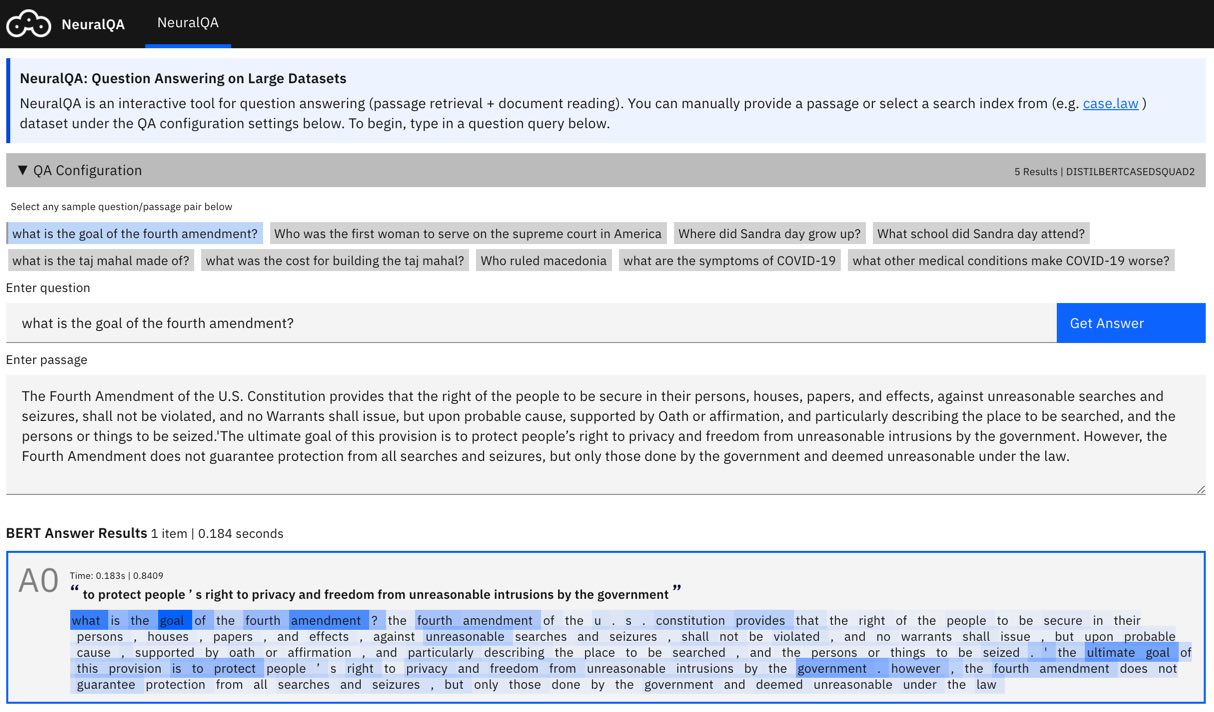
NeuralQA provides an easy to use api and visual interface for Extractive Question Answering (QA), on large datasets. The QA process is comprised of two main stages - Passage retrieval (Retriever) is implemented using ElasticSearch and Document Reading (Reader) is implemented using pretrained BERT models via the Huggingface Transformers api.
Usage
pip3 install neuralqa
Create (or navigate to) a folder you would like to use with NeuralQA. Run the following command line instruction within that folder.
neuralqa ui --port 4000
navigate to http://localhost:4000/#/ to view the NeuralQA interface. Learn about other command line options in the documentation here or how to configure NeuralQA to use your own reader models or retriever instances.
Note: To use NeuralQA with a retriever such as ElasticSearch, follow the instructions here to download, install, and launch a local elasticsearch instance and add it to your config.yaml file.
How Does it Work?
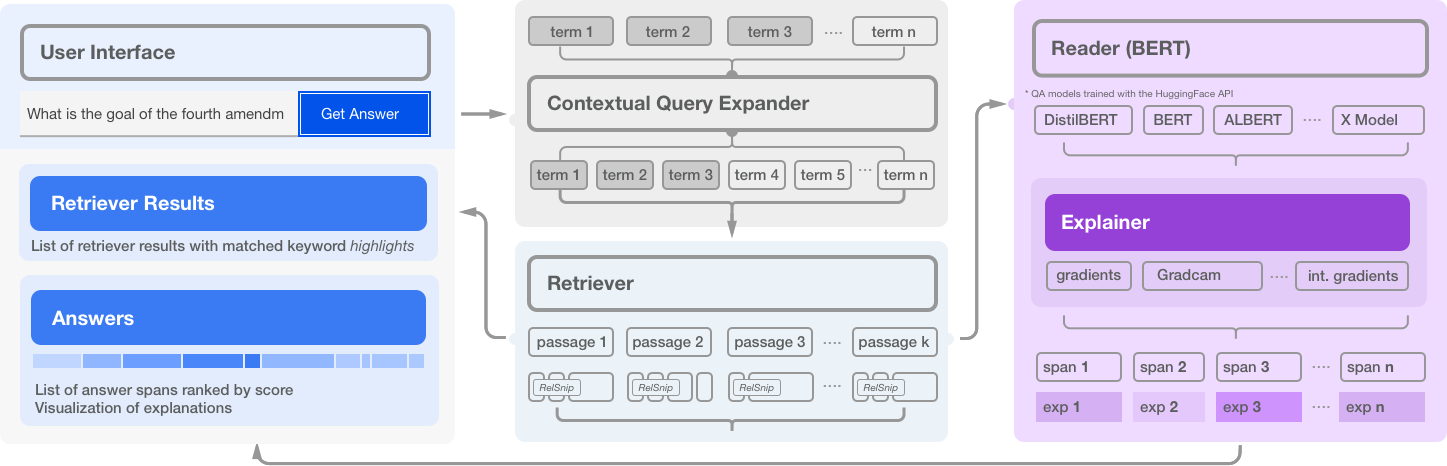
NeuralQA is comprised of several high level modules:
-
Retriever: For each search query (question), scan an index (elasticsearch), and retrieve a list of candidate matched passages.
-
Reader: For each retrieved passage, a BERT based model predicts a span that contains the answer to the question. In practice, retrieved passages may be lengthy and BERT based models can process a maximum of 512 tokens at a time. NeuralQA handles this in two ways. Lengthy passages are chunked into smaller sections with a configurable stride. Secondly, NeuralQA offers the option of extracting a subset of relevant snippets (RelSnip) which a BERT reader can then scan to find answers. Relevant snippets are portions of the retrieved document that contain exact match results for the search query.
-
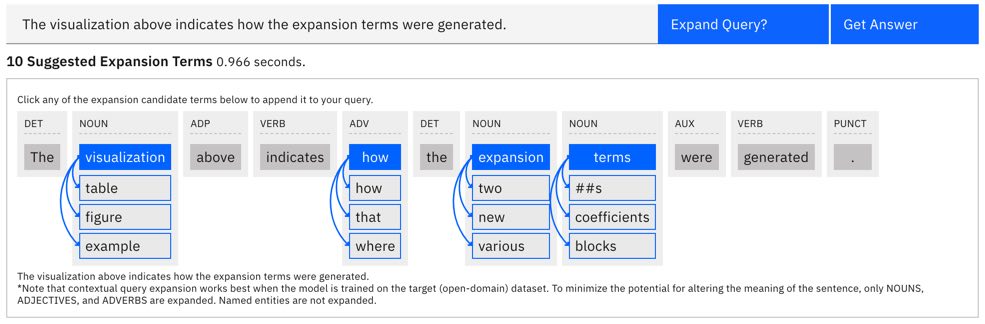
Expander: Methods for generating additional (relevant) query terms to improve recall. Currently, we implement Contextual Query Expansion using finetuned Masked Language Models. This is implemented via a user in the loop flow where the user can choose to include any suggested expansion terms.
- User Interface: NeuralQA provides a visual user interface for performing queries (manual queries where question and context are provided as well as queries over a search index), viewing results and also sensemaking of results (reranking of passages based on answer scores, highlighting keyword match, model explanations).
Configuration
Properties of modules within NeuralQA (ui, retriever, reader, expander) can be specified via a yaml configuration file. When you launch the ui, you can specify the path to your config file --config-path. If this is not provided, NeuralQA will search for a config.yaml in the current folder or create a default copy) in the current folder. Sample configuration shown below:
ui:
  queryview:
    intro:
      title: "NeuralQA: Question Answering on Large Datasets"
      subtitle: "Subtitle of your choice"
    views: # select sections of the ui to hide or show
      intro: True
      advanced: True
      samples: False
      passages: True
      explanations: True
      allanswers: True
    options: # values for advanced options
      stride: ..
      maxpassages: ..
      highlightspan: ..

  header: # header tile for ui
    appname: NeuralQA
    appdescription: Question Answering on Large Datasets

reader:
  title: Reader
  selected: twmkn9/distilbert-base-uncased-squad2
  options:
    - name: DistilBERT SQUAD2
      value: twmkn9/distilbert-base-uncased-squad2
      type: distilbert
    - name: BERT SQUAD2
      value: deepset/bert-base-cased-squad2
      type: bert
Documentation
An attempt is being made to better document NeuralQA here - https://victordibia.github.io/neuralqa/.
Citation
A paper introducing NeuralQA and its components can be found here.
@article{dibia2020neuralqa,
    title={NeuralQA: A Usable Library for Question Answering (Contextual Query Expansion + BERT) on Large Datasets},
    author={Victor Dibia},
    year={2020},
    journal={Proceedings of the 2020 Conference on Empirical Methods in Natural Language Processing and the 9th International Joint Conference on Natural Language Processing (EMNLP-IJCNLP): System Demonstrations}
}

 3 Jun 13, 2022
 41 Dec 15, 2022
 1 Mar 16, 2022
 3 Oct 15, 2021
 1 Jan 04, 2022
 1.3k Jan 01, 2023
 1.6k Dec 25, 2022
 410 Jan 03, 2023
 46 Dec 14, 2022
 125 Dec 20, 2022
 2 Nov 17, 2021
 83 Jan 09, 2023
 22 Oct 27, 2021
 171 Nov 21, 2022
 79 Dec 26, 2022
 409 Jan 06, 2023
 41 Nov 18, 2022
 220 Dec 30, 2022
 23 Oct 09, 2022
 5.1k Dec 30, 2022