当前位置:网站首页>Wu Enda's machine learning assignment -- Logical Regression
Wu Enda's machine learning assignment -- Logical Regression
2022-04-22 02:27:00 【ManiacLook】
1 Logistic regression
In this part of the exercise , You will build a logistic regression model to predict whether a student can enter college . Suppose you are an administrator of a University , Based on the results of the two exams , To decide whether each applicant is admitted . You have historical data on previous Applicants , It can be used as a logistic regression training set . For each training sample , You have the scores of the applicant's two evaluations and the results of admission . To accomplish this prediction task , We are going to build a classification model that can evaluate the possibility of admission based on two test scores .
1.1 Visualizing the data
Before starting to implement the algorithm , It is best to visualize the data
Add library
import pandas as pd
import matplotlib.pyplot as plt
import numpy as np
from sklearn.metrics import classification_report
Read training set data
path = 'ex2data1.txt'
data = pd.read_csv(path, header=None, names=['exam 1 score', 'exam 2 score', 'admitted'])
# print(data.head())
# print(data.describe())
Draw the positive and negative classes in the form of scatter diagram
#  Separate admission and non admission data
positive = data[data.admitted.isin(['1'])]
negative = data[data.admitted.isin(['0'])]

#  Visual training set data
fig, ax = plt.subplots(figsize=(6, 5))
ax.scatter(positive['exam 1 score'], positive['exam 2 score'], c='black', marker='+', label='admitted')
ax.scatter(negative['exam 1 score'], negative['exam 2 score'], c='yellow', marker='o', label='not admitted')
ax.legend(loc=2)  #  Data point notes
ax.set_xlabel('exam 1 score')
ax.set_ylabel('exam 2 score')
ax.set_title('trainging data')

1.2 sigmoid function
def sigmoid(x):
    return np.exp(x) / (1 + np.exp(x))
1.3 Cost function
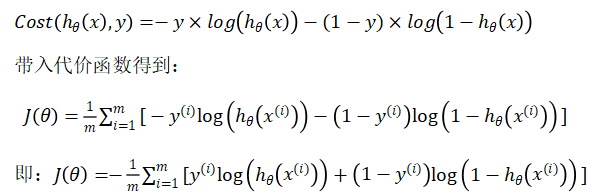
def computecost(X, y, theta):
    theta = np.matrix(theta)
    X = np.matrix(X)
    y = np.matrix(y)
    first = np.multiply(-y, np.log(sigmoid(np.dot(X, theta.T))))
    second = np.multiply((1 - y), np.log(1 - sigmoid(np.dot(X, theta.T))))
    return np.sum(first - second) / (len(X))
1.4 gradient descent

def gradientdescent(X, y, theta, alpha, epoch):
    temp = np.matrix(np.zeros(theta.shape))
    m = X.shape[0]
    cost = np.zeros(epoch)

    for i in range(epoch):
        A = sigmoid(np.dot(X, theta.T))
        temp = theta - (alpha / m) * (A - y).T * X
        theta = temp
        cost[i] = computecost(X, y, theta)

    return theta, cost
1.5 Training theta Parameters
Before training, normalize the students' scores
data.insert(0, 'Ones', 100)
cols = data.shape[1]  #  Number of columns
X = data.iloc[:, 0:cols - 1]
y = data.iloc[:, cols - 1:cols]
# theta = np.zeros(X.shape[1])
theta = np.ones(3)
X = np.matrix(X)
X = X / 100  #  normalization
y = np.matrix(y)
theta = np.matrix(theta)
Training begins
alpha = 0.3
epoch = 100000
origin_cost = computecost(X, y, theta)
final_theta, cost = gradientdescent(X, y, theta, alpha, epoch)
Output theta Parameters
print(final_theta)
# [[-24.99361363 20.48877093 20.01095566]]
1.6 Evaluation algorithm
Prediction function , Enter student grades , Output the probability of admission
def predict(theta, X):
    probability = sigmoid(np.dot(X, theta.T))
    return [1 if x >= 0.5 else 0 for x in probability]
Check the accuracy
predictions = predict(final_theta, X)
correct = [1 if a == b else 0 for (a, b) in zip(predictions, y)]
accuracy = sum(correct) / len(X)
print(accuracy)
#  Output  0.89
Or use sklearn To test
from sklearn.metrics import classification_report
print(classification_report(predictions, y))
              precision    recall  f1-score   support

           0       0.85      0.87      0.86        39
           1       0.92      0.90      0.91        61

    accuracy                           0.89       100
   macro avg       0.88      0.89      0.88       100
weighted avg       0.89      0.89      0.89       100
The cost function changes
fig, ax = plt.subplots()
ax.plot(np.arange(epoch), cost, 'r')
ax.set_xlabel('Iterations')
ax.set_ylabel('Cost')
ax.set_title('Cost vs. Training Epoch')
plt.show()

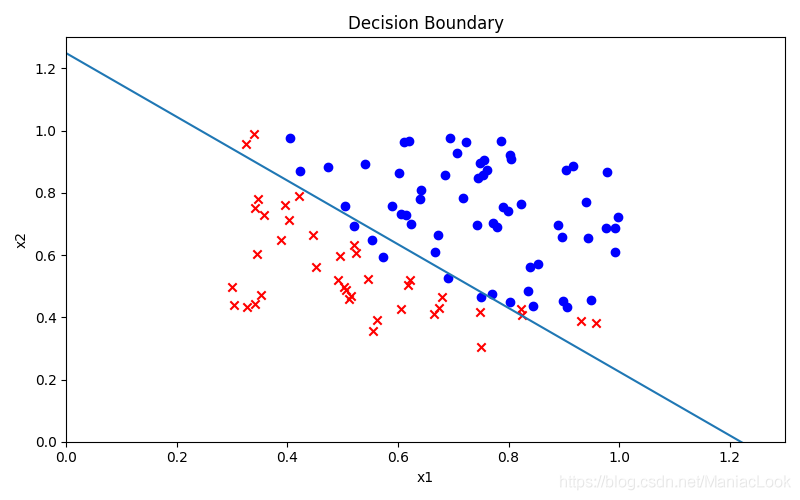
1.7 Decision boundaries

x1 = np.arange(1.3, step=0.01)
x2 = -(final_theta[0, 0] + x1 * final_theta[0, 1]) / final_theta[0, 2]

fig, ax = plt.subplots(figsize=(8, 5))
ax.scatter(positive['exam 1 score'] / 100, positive['exam 2 score'] / 100, c='b', label='Admitted')
ax.scatter(negative['exam 1 score'] / 100, negative['exam 2 score'] / 100, c='r', marker='x', label='Not Admitted')
ax.plot(x1, x2)
ax.set_xlim(0, 1.3)
ax.set_ylim(0, 1.3)
ax.set_xlabel('x1')
ax.set_ylabel('x2')
ax.set_title('Decision Boundary')
plt.show()
Decision boundary diagram
2 Regularized logistic regression
In this part of the exercise , You will implement regularized logistic regression , To predict whether the microchip of the manufacturer passes the quality assurance (QA). stay QA In the process , Every microchip has to go through various tests , To make sure it works .
Suppose you are the product manager of the factory , You did two different tests on the test results of some microchips . From these two tests , Whether you want to accept microchip or whether you want to reject microchip . To help you make a decision , You have a data set of past chip test results , From which you can build a logistic regression model .
2.1 Visualizing the data
First read the training set
data = pd.read_csv('ex2data2.txt', names=['Test 1', 'Test 2', 'Accepted'])
print(data.head())
print(data.describe())
Output results
     Test 1   Test 2  Accepted
0  0.051267  0.69956         1
1 -0.092742  0.68494         1
2 -0.213710  0.69225         1
3 -0.375000  0.50219         1
4 -0.513250  0.46564         1
           Test 1      Test 2    Accepted
count  118.000000  118.000000  118.000000
mean     0.054779    0.183102    0.491525
std      0.496654    0.519743    0.502060
min     -0.830070   -0.769740    0.000000
25%     -0.372120   -0.254385    0.000000
50%     -0.006336    0.213455    0.000000
75%      0.478970    0.646562    1.000000
max      1.070900    1.108900    1.000000
Then draw a picture
#  data classification
positive = data[data.Accepted.isin(['1'])]
negative = data[data.Accepted.isin(['0'])]

#  Visualization data
fig, ax = plt.subplots(figsize=(6, 4))
ax.scatter(positive['Test 1'], positive['Test 2'], c='black', marker='+', label='y=1')
ax.scatter(negative['Test 1'], negative['Test 2'], c='yellow', marker='o', label='y=0')
ax.legend(loc=1)
ax.set_xlabel('Microchip Test 1')
ax.set_ylabel('Microchip Test 2')
ax.set_title('Plot of training data')
plt.show()

2.2 Feature mapping
One way to better fit the data is to create more features from each data point . We will map features to x1 and x2 All polynomial terms of , Until the sixth power . Computation (1 + x1 + x2 + x12 + x1x2 + x22 + … + x1x25 + x26)

#  Feature mapping
def feature_mapping(x1, x2, power):
    data2 = {
    }
    for i in np.arange(power + 1):
        for p in np.arange(i + 1):
            data2["f{}{}".format(i - p, p)] = np.power(x1, i - p) * np.power(x2, p)
    return pd.DataFrame(data2)


#  Calculation 6 Characteristic mapping of order
x1 = data['Test 1'].values
x2 = data['Test 2'].values
data2 = feature_mapping(x1, x2, 6)
print(data2.head())
   f00       f10      f01       f20  ...       f33       f24       f15       f06
0  1.0  0.051267  0.69956  0.002628  ...  0.000046  0.000629  0.008589  0.117206
1  1.0 -0.092742  0.68494  0.008601  ... -0.000256  0.001893 -0.013981  0.103256
2  1.0 -0.213710  0.69225  0.045672  ... -0.003238  0.010488 -0.033973  0.110047
3  1.0 -0.375000  0.50219  0.140625  ... -0.006679  0.008944 -0.011978  0.016040
4  1.0 -0.513250  0.46564  0.263426  ... -0.013650  0.012384 -0.011235  0.010193
As a result of this mapping , Our two eigenvectors ( Two QA Test score ) Converted to 28 Dimension vector . Trained on this high-dimensional eigenvector logistic Regression classifiers will have more complex decision boundaries , And there will be nonlinearity when drawing in our two-dimensional diagram .
Although feature mapping allows us to build more expressive classifiers , But it's also easier to over fit . In the next part of the exercise , You will implement regularization logistic Regression to fit the data , We'll also see for ourselves how regularization can help solve the over fitting problem .
2.3 Cost function and gradient
Now implement the code to compute the regular logistic The cost function and gradient of regression .
Think about it ,logistic The regularization cost function in regression is

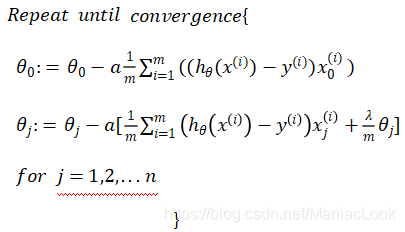
Please note that , Parameters should not be regularized θ0.
The gradient of the cost function is a vector , Among them the first j The elements are defined as follows :
# sigmoid  function
def sigmoid(x):
    return 1 / (1 + np.exp(-x))


#  Cost function
def cost(theta, X, y):
    first = (-y) * np.log(sigmoid(X @ theta))
    second = (1 - y) * np.log(1 - sigmoid(X @ theta))
    return np.mean(first - second)


#  Regularization cost function
def costreg(theta, X, y, learningrate):
    _theta = theta[1:]
    reg = (learningrate / (2 * len(X))) * (_theta @ _theta)
    return cost(theta, X, y) + reg
#  gradient
def gradient(theta, X, y):
    return (X.T @ (sigmoid(X @ theta) - y)) / len(X)


#  Regularized gradient
def gradientreg(theta, X, y, learningrate):
    reg = (learningrate / len(X)) * theta
    reg[0] = 0  #  No punishment θ0
    return gradient(theta, X, y) + reg
2.4 Training parameters θ
Get the training set and initialize θ by 0
X = data2.values
y = data['Accepted'].values
theta = np.zeros(X.shape[1])
print(X.shape, y.shape, theta.shape)
print(costreg(theta, X, y, 1))
(118, 28) (118,) (28,)
0.6931471805599454
(1) use fmin_tnc Function training
result1 = opt.fmin_tnc(func=costreg, x0=theta, fprime=gradientreg, args=(X, y, 2))
print(result1)
(array([ 1.02253248,  0.56283944,  1.13465456, -1.78529748, -0.66539169,
       -1.01863181,  0.13957059, -0.29358911, -0.30102279, -0.08324363,
       -1.27205982, -0.06137378, -0.53996494, -0.17881798, -0.94198718,
       -0.14054843, -0.17736659, -0.07697368, -0.22918936, -0.21349659,
       -0.37205336, -0.86417647,  0.00890082, -0.26795949, -0.0036225 ,
       -0.28315229, -0.07321593, -0.75992548]), 57, 1)
(2) use minimize Function training
result2 = opt.minimize(fun=costreg, x0=theta, args=(X, y, 2), method='TNC', jac=gradientreg)
print(result2)
fun: 0.5830356764058148
     jac: array([0.00318613, 0.00371841, 0.01438163, 0.00439174, 0.0042439 ,
       0.01363881, 0.0025095 , 0.00300901, 0.00121719, 0.01128844,
       0.00351398, 0.00083453, 0.00220748, 0.00131178, 0.0112205 ,
       0.00258022, 0.00113796, 0.00020022, 0.0017479 , 0.00077718,
       0.00942953, 0.00305894, 0.00032368, 0.0007994 , 0.00012105,
       0.00142873, 0.00056985, 0.00951201])
 message: 'Converged (|f_n-f_(n-1)| ~= 0)'
    nfev: 57
     nit: 2
  status: 1
 success: True
       x: array([ 1.02253248,  0.56283944,  1.13465456, -1.78529748, -0.66539169,
       -1.01863181,  0.13957059, -0.29358911, -0.30102279, -0.08324363,
       -1.27205982, -0.06137378, -0.53996494, -0.17881798, -0.94198718,
       -0.14054843, -0.17736659, -0.07697368, -0.22918936, -0.21349659,
       -0.37205336, -0.86417647,  0.00890082, -0.26795949, -0.0036225 ,
       -0.28315229, -0.07321593, -0.75992548])
2.5 Evaluating logistic regression
final_theta = result1[0]
predictions = predict(final_theta, X)
correct = [1 if a == b else 0 for (a, b) in zip(predictions, y)]
accuracy = sum(correct) / len(X)
print(accuracy)

final_theta = result2.x
predictions = predict(final_theta, X)
correct = [1 if a == b else 0 for (a, b) in zip(predictions, y)]
accuracy = sum(correct) / len(X)
print(accuracy)

from sklearn.metrics import classification_report
print(classification_report(y, predictions))
0.8050847457627118
0.8050847457627118

              precision    recall  f1-score   support

           0       0.85      0.75      0.80        60
           1       0.77      0.86      0.81        58

    accuracy                           0.81       118
   macro avg       0.81      0.81      0.80       118
weighted avg       0.81      0.81      0.80       118
2.6 Decision boundaries
x = np.linspace(-1, 1.5, 250)
xx, yy = np.meshgrid(x, x)

z = feature_mapping(xx.ravel(), yy.ravel(), 6).values
z = z @ final_theta
z = z.reshape(xx.shape)

fig, ax = plt.subplots()
ax.scatter(positive['Test 1'], positive['Test 2'], c='black', marker='+', label='y=1')
ax.scatter(negative['Test 1'], negative['Test 2'], c='yellow', marker='o', label='y=0')
ax.legend(loc=1)
ax.set_xlabel('Microchip Test 1')
ax.set_ylabel('Microchip Test 2')
ax.set_title('Plot of training data')
plt.contour(xx, yy, z, 0)  #  contour
plt.ylim(-0.8, 1.2)
plt.show()
The following figure for λ \lambda λ = 2 The decision boundary of

λ \lambda λ = 0 when

λ \lambda λ = 100 when

版权声明
本文为[ManiacLook]所创,转载请带上原文链接,感谢
https://yzsam.com/2022/04/202204220222435170.html
边栏推荐
- 当人们越是接近产业互联网,就越来越能真正的看清它
- 49 pages enterprise digital transformation cases and common tools enterprise digital transformation ideas
- SQLSERVER解析JSON时string value中换行符问题
- Header DHCP service configuration
- 14. System information viewing
- STM32 FLASH操作
- OpenCV计算图像的梯度特征
- Analysis of five data structures of redis
- 面试题:用程序实现两个线程交替打印 0~100 的奇偶数
- Fluent music player audioplayer
猜你喜欢

Unity Game Optimization - Third Edition 阅读笔记 Chapter 1 分析性能问题

高级UI都没弄明白凭什么拿高薪,劲爆

NLP model summary

2022年物联网安全的发展趋势

Introduction to Alibaba's super large-scale Flink cluster operation and maintenance system
![[timing] reformer: local sensitive hash (LSH) to achieve efficient transformer paper notes](/img/8a/2214bb4f8595ac2d0871cb2c190f00.png)
[timing] reformer: local sensitive hash (LSH) to achieve efficient transformer paper notes

What do you learn about programming

《k3s 源码解析2 ----master逻辑源码分析》

Pychar executes multiple script files at the same time

illustrator(AI)的画板大小尺寸修改快捷键默认是Shift+O
随机推荐
Header DHCP service configuration
MySQL Chapter 1 Introduction to database
ctf-wiki本地搭建记录
机器学习、深度学习知识点
JMeter + Jenkins + ant persistence
Unity Game Optimization - Third Edition 阅读笔记 Chapter 1 分析性能问题
Basic operation of MySQL database ------ (basic addition, deletion, query and modification)
Mysql database fields move up and down
Opencv calculates the gradient feature of the image
When people get closer to the industrial Internet, they can see it more and more clearly
Use Wx The showactionsheet selection box modifies the information in the database. Why does it report an error that data is not defined
Evaluation of arithmetic four mixed operation expression
User interaction, formatted output, basic operators
Detailed explanation of spark SQL underlying execution process
DEJA_ Vu3d - cesium feature set 012 - military plotting Series 6: Custom polygons
像堆乐高一样解释神经网络的数学过程
互联网行业为什么能吸引越来越多的年轻人?尤其是程序员……
Explain the mathematical process of neural network like a pile of LEGO
Analysis of header NAT & DHCP protocol
Use of swift generics