Beginner-friendly repository for Hacktober Fest 2021. Start your contribution to open source through baby steps. 💜

Overview

Hacktober Fest 2021

🎉 Open source is changing the world – one contribution at a time! 🎉


This repository is made for beginners who are unfamiliar with open source and GitHub. So what is holding you back?! Make your first contribution to the open source and take home swags. 👕 📦

What is Hacktober Fest?

Hacktoberfest is a month-long open source contribution program hosted by DigitalOcean in the month of October for supporting open source development. Hacktoberfest encourages participation in the open source community, which grows bigger every year. Whether you are a pro in programming or a newbie, Hacktoberfest welcomes each one of the contributors for providing their valuable contribution to the open source community. Completing the challenge earns you a limited edition swags and other exiciting goodies.

How to receive swags?

  • Register yourself at the Hacktober Fest Website
  • Create 4 pull-requests from repositories participating in the challenge (repositories having hacktoberfest topic)
  • Successfully merged PRs will be validated further for 14 days.
  • After that, the PR is accepted
  • Remember! All PRs must be done between October 1 to October 31 to be eligible for swags.
  • This year the first 55,000 participants will be eligible for the prize.

How to contribute?

Read RULES.md before creating a pull request

PRs violating the rules will be closed and reported Spam!

If you're not comfortable with command line, here are tutorials using GUI tools. If you don't have git on your machine, install it.

1. Fork the repository.
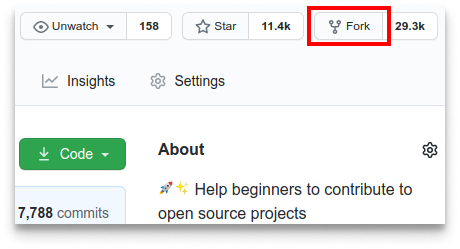
fork this repository

2. Clone your forked copy of the project.

git clone  https://github.com/abhilashmnair/HacktoberFest2021.git

3. Navigate to the project directory 📁 .

cd HacktoberFest2021

4. Add a reference(remote) to the original repository.

git remote add upstream https://github.com/abhilashmnair/HacktoberFest2021.git

5. Check the remotes for this repository.

git remote -v

6. Always take a pull from the upstream repository to your master branch to keep it at par with the main project(updated repository).

git pull upstream main

7. Create a new branch.

git checkout -b <your_branch_name>

8. Perform your desired changes to the code base.

9. Track your changes ✔️ .

git add *

10. Commit your changes .

git commit -m "Message"

11. Push the committed changes in your feature branch to your remote repo.

git push -u origin <your_branch_name>

12. To create a pull request, click on compare and pull requests. Please ensure you compare your feature branch to the desired branch of the repository you are supposed to make a PR to.

Not a developer or programmer? Don't worry! Add useful documentation and fix grammatical errors in the README file. Every single contribution of yours will benefit your open source venture.

License

This repository and the contained files are licensed under MIT License. See LICENSE for full text.


💜 Thank You for your participation! 💜

Owner
Abhilash M Nair
Abhilash M Nair
Code release for NeuS

NeuS We present a novel neural surface reconstruction method, called NeuS, for reconstructing objects and scenes with high fidelity from 2D image inpu

Peng Wang 813 Jan 04, 2023
Python package for visualizing the loss landscape of parameterized quantum algorithms.

orqviz A Python package for easily visualizing the loss landscape of Variational Quantum Algorithms by Zapata Computing Inc. orqviz provides a collect

Zapata Computing, Inc. 75 Dec 30, 2022
Clustergram - Visualization and diagnostics for cluster analysis in Python

Clustergram Visualization and diagnostics for cluster analysis Clustergram is a diagram proposed by Matthias Schonlau in his paper The clustergram: A

Martin Fleischmann 96 Dec 26, 2022
Contains a bunch of different python programm tasks

py_tasks Contains a bunch of different python programm tasks Armstrong.py - calculate Armsrong numbers in range from 0 to n with / without cache and c

Dmitry Chmerenko 1 Dec 17, 2021
Official pytorch implementation of paper Dual-Level Collaborative Transformer for Image Captioning (AAAI 2021).

Dual-Level Collaborative Transformer for Image Captioning This repository contains the reference code for the paper Dual-Level Collaborative Transform

lyricpoem 160 Dec 11, 2022
Differentiable rasterization applied to 3D model simplification tasks

nvdiffmodeling Differentiable rasterization applied to 3D model simplification tasks, as described in the paper: Appearance-Driven Automatic 3D Model

NVIDIA Research Projects 336 Dec 30, 2022
Over-the-Air Ensemble Inference with Model Privacy

Over-the-Air Ensemble Inference with Model Privacy This repository contains simulations for our private ensemble inference method. Installation Instal

Selim Firat Yilmaz 1 Jun 29, 2022
A PyTorch implementation of Implicit Q-Learning

IQL-PyTorch This repository houses a minimal PyTorch implementation of Implicit Q-Learning (IQL), an offline reinforcement learning algorithm, along w

Garrett Thomas 30 Dec 12, 2022
Video-Captioning - A machine Learning project to generate captions for video frames indicating the relationship between the objects in the video

Video-Captioning - A machine Learning project to generate captions for video frames indicating the relationship between the objects in the video

1 Jan 23, 2022
This is the code for the paper "Jinkai Zheng, Xinchen Liu, Wu Liu, Lingxiao He, Chenggang Yan, Tao Mei: Gait Recognition in the Wild with Dense 3D Representations and A Benchmark. (CVPR 2022)"

Gait3D-Benchmark This is the code for the paper "Jinkai Zheng, Xinchen Liu, Wu Liu, Lingxiao He, Chenggang Yan, Tao Mei: Gait Recognition in the Wild

82 Jan 04, 2023
Simple Tensorflow implementation of "Adaptive Convolutions for Structure-Aware Style Transfer" (CVPR 2021)

AdaConv — Simple TensorFlow Implementation [Paper] : Adaptive Convolutions for Structure-Aware Style Transfer (CVPR 2021) Note This repository does no

Junho Kim 26 Nov 18, 2022
A PyTorch implementation of NeRF (Neural Radiance Fields) that reproduces the results.

NeRF-pytorch NeRF (Neural Radiance Fields) is a method that achieves state-of-the-art results for synthesizing novel views of complex scenes. Here are

Yen-Chen Lin 3.2k Jan 08, 2023
System Design course at HSE (2021)

System Design course at HSE (2021) Wiki-страница курса Структура репозитория: slides - директория с презентациями с занятий tasks - материалы для выпо

22 Dec 25, 2022
Deep Learning for Human Part Discovery in Images - Chainer implementation

Deep Learning for Human Part Discovery in Images - Chainer implementation NOTE: This is not official implementation. Original paper is Deep Learning f

Shintaro Shiba 63 Sep 25, 2022
Proof-Of-Concept Piano-Drums Music AI Model/Implementation

Rock Piano "When all is one and one is all, that's what it is to be a rock and not to roll." ---Led Zeppelin, "Stairway To Heaven" Proof-Of-Concept Pi

Alex 4 Nov 28, 2021
Attention-based CNN-LSTM and XGBoost hybrid model for stock prediction

Attention-based CNN-LSTM and XGBoost hybrid model for stock prediction Requirements The code has been tested running under Python 3.7.4, with the foll

zshicode 84 Jan 01, 2023
Global-Local Path Networks for Monocular Depth Estimation with Vertical CutDepth [Paper]

Global-Local Path Networks for Monocular Depth Estimation with Vertical CutDepth [Paper] Downloads [Downloads] Trained ckpt files for NYU Depth V2 and

98 Jan 01, 2023
Tensorflow Implementation of ECCV'18 paper: Multimodal Human Motion Synthesis

MT-VAE for Multimodal Human Motion Synthesis This is the code for ECCV 2018 paper MT-VAE: Learning Motion Transformations to Generate Multimodal Human

Xinchen Yan 36 Oct 02, 2022
A Transformer-Based Feature Segmentation and Region Alignment Method For UAV-View Geo-Localization

University1652-Baseline [Paper] [Slide] [Explore Drone-view Data] [Explore Satellite-view Data] [Explore Street-view Data] [Video Sample] [中文介绍] This

Zhedong Zheng 335 Jan 06, 2023
CarND-LaneLines-P1 - Lane Finding Project for Self-Driving Car ND

Finding Lane Lines on the Road Overview When we drive, we use our eyes to decide where to go. The lines on the road that show us where the lanes are a

Udacity 769 Dec 27, 2022