Unofficial PyTorch implementation of TokenLearner by Google AI

Overview

tokenlearner-pytorch

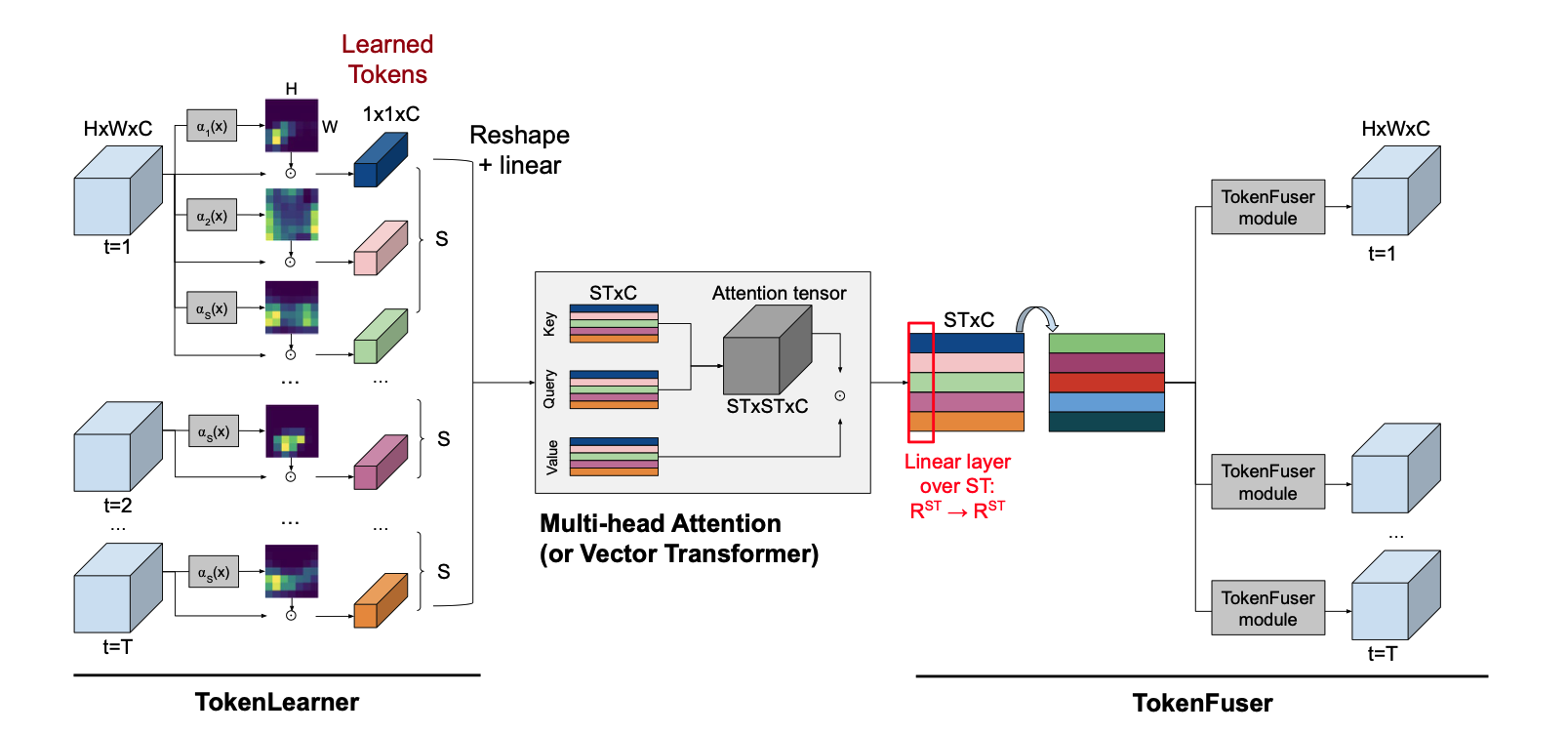
Unofficial PyTorch implementation of TokenLearner by Ryoo et al. from Google AI (abs, pdf)
Installation

You can install TokenLearner via pip:

pip install tokenlearner-pytorch

Usage

You can access the TokenLearner class from the tokenlearner_pytorch package. You can use this layer with a Vision Transformer, MLPMixer, or Video Vision Transformer as done in the paper.

import torch
from tokenlearner_pytorch import TokenLearner

tklr = TokenLearner(S=8)
x = torch.rand(512, 32, 32, 3)
y = tklr(x) # [512, 8, 3]

You can also use TokenLearner and TokenFuser together with Multi-head Self-Attention as done in the paper:

import torch
import torch.nn as nn
from tokenlearner_pytorch import TokenLearner, TokenFuser

mhsa = nn.MultiheadAttention(3, 1)
tklr = TokenLearner(S=8)
tkfr = TokenFuser(H=32, W=32, C=3, S=8)

x = torch.rand(512, 32, 32, 3) # a batch of images

y = tklr(x)
y = y.view(8, 512, 3)
y, _ = mhsa(y, y, y) # ignore attn weights
y = y.view(512, 8, 3)

out = tkfr(y, x) # [512, 32, 23, 3]

TODO

  • Add support for temporal dimension T
  • Implement TokenFuser with ViT
  • Implement TokenFuser with ViViT

Contributions

If I've made any errors or you have any suggestions, feel free to raise an Issue or PR. All contributions welcome!!

License

MIT

Owner
Rishabh Anand
CS undergrad + ML Research @ NUS • Open-source Jedi • Writer
Rishabh Anand
Implementation of " SESS: Self-Ensembling Semi-Supervised 3D Object Detection" (CVPR2020 Oral)

SESS: Self-Ensembling Semi-Supervised 3D Object Detection Created by Na Zhao from National University of Singapore Introduction This repository contai

125 Dec 23, 2022
High level network definitions with pre-trained weights in TensorFlow

TensorNets High level network definitions with pre-trained weights in TensorFlow (tested with 2.1.0 = TF = 1.4.0). Guiding principles Applicability.

Taehoon Lee 1k Dec 13, 2022
Implementation of Pooling by Sliced-Wasserstein Embedding (NeurIPS 2021)

PSWE: Pooling by Sliced-Wasserstein Embedding (NeurIPS 2021) PSWE is a permutation-invariant feature aggregation/pooling method based on sliced-Wasser

Navid Naderializadeh 3 May 06, 2022
A PyTorch implementation of "Signed Graph Convolutional Network" (ICDM 2018).

SGCN ⠀ A PyTorch implementation of Signed Graph Convolutional Network (ICDM 2018). Abstract Due to the fact much of today's data can be represented as

Benedek Rozemberczki 251 Nov 30, 2022
Pretrained models for Jax/Haiku; MobileNet, ResNet, VGG, Xception.

Pre-trained image classification models for Jax/Haiku Jax/Haiku Applications are deep learning models that are made available alongside pre-trained we

Alper Baris CELIK 14 Dec 20, 2022
(Py)TOD: Tensor-based Outlier Detection, A General GPU-Accelerated Framework

(Py)TOD: Tensor-based Outlier Detection, A General GPU-Accelerated Framework Background: Outlier detection (OD) is a key data mining task for identify

Yue Zhao 127 Jan 05, 2023
Putting NeRF on a Diet: Semantically Consistent Few-Shot View Synthesis Implementation

Putting NeRF on a Diet: Semantically Consistent Few-Shot View Synthesis Implementation This project attempted to implement the paper Putting NeRF on a

254 Dec 27, 2022
Final report with code for KAIST Course KSE 801.

Orthogonal collocation is a method for the numerical solution of partial differential equations

Chuanbo HUA 4 Apr 06, 2022
This is my codes that can visualize the psnr image in testing videos.

CVPR2018-Baseline-PSNRplot This is my codes that can visualize the psnr image in testing videos. Future Frame Prediction for Anomaly Detection – A New

Wenhao Yang 12 May 29, 2021
Dialect classification

Dialect-Classification This repository presents the data that was used in a talk at ICKL-5 (5th International Conference on Kurdish Linguistics) at th

Kurdish-BLARK 0 Nov 12, 2021
Deep Multi-Magnification Network for multi-class tissue segmentation of whole slide images

Deep Multi-Magnification Network This repository provides training and inference codes for Deep Multi-Magnification Network published here. Deep Multi

Computational Pathology 12 Aug 06, 2022
The reference baseline of final exam for XMU machine learning course

Mini-NICO Baseline The baseline is a reference method for the final exam of machine learning course. Requirements Installation we use /python3.7 /torc

JoaquinChou 3 Dec 29, 2021
An end-to-end machine learning library to directly optimize AUC loss

LibAUC An end-to-end machine learning library for AUC optimization. Why LibAUC? Deep AUC Maximization (DAM) is a paradigm for learning a deep neural n

Andrew 75 Dec 12, 2022
An implementation of the AdaOPS (Adaptive Online Packing-based Search), which is an online POMDP Solver used to solve problems defined with the POMDPs.jl generative interface.

AdaOPS An implementation of the AdaOPS (Adaptive Online Packing-guided Search), which is an online POMDP Solver used to solve problems defined with th

9 Oct 05, 2022
Code, pre-trained models and saliency results for the paper "Boosting RGB-D Saliency Detection by Leveraging Unlabeled RGB Images".

Boosting RGB-D Saliency Detection by Leveraging Unlabeled RGB This repository is the official implementation of the paper. Our results comming soon in

Xiaoqiang Wang 8 May 22, 2022
Implementation for the "Surface Reconstruction from 3D Line Segments" paper.

Surface Reconstruction from 3D Line Segments Surface reconstruction from 3d line segments. Langlois, P. A., Boulch, A., & Marlet, R. In 2019 Internati

85 Jan 04, 2023
DL course co-developed by YSDA, HSE and Skoltech

Deep learning course This repo supplements Deep Learning course taught at YSDA and HSE @fall'21. For previous iteration visit the spring21 branch. Lec

Yandex School of Data Analysis 1.3k Dec 30, 2022
Hyperparameter tuning for humans

KerasTuner KerasTuner is an easy-to-use, scalable hyperparameter optimization framework that solves the pain points of hyperparameter search. Easily c

Keras 2.6k Dec 27, 2022
Lowest memory consumption and second shortest runtime in NTIRE 2022 challenge on Efficient Super-Resolution

FMEN Lowest memory consumption and second shortest runtime in NTIRE 2022 on Efficient Super-Resolution. Our paper: Fast and Memory-Efficient Network T

33 Dec 01, 2022