ChineseBERT: Chinese Pretraining Enhanced by Glyph and Pinyin Information
This repository contains code, model, dataset for ChineseBERT at ACL2021.
ChineseBERT: Chinese Pretraining Enhanced by Glyph and Pinyin Information
Zijun Sun, Xiaoya Li, Xiaofei Sun, Yuxian Meng, Xiang Ao, Qing He, Fei Wu and Jiwei Li
Guide
| Section | Description |
|---|---|
| Introduction | Introduction to ChineseBERT |
| Download | Download links for ChineseBERT |
| Quick tour | Learn how to quickly load models |
| Experiment | Experiment results on different Chinese NLP datasets |
| Citation | Citation |
| Contact | How to contact us |
Introduction
We propose ChineseBERT, which incorporates both the glyph and pinyin information of Chinese characters into language model pretraining.
First, for each Chinese character, we get three kind of embedding.
- Char Embedding: the same as origin BERT token embedding.
- Glyph Embedding: capture visual features based on different fonts of a Chinese character.
- Pinyin Embedding: capture phonetic feature from the pinyin sequence ot a Chinese Character.
Then, char embedding, glyph embedding and pinyin embedding are first concatenated, and mapped to a D-dimensional embedding through a fully connected layer to form the fusion embedding.
Finally, the fusion embedding is added with the position embedding, which is fed as input to the BERT model.
The following image shows an overview architecture of ChineseBERT model.
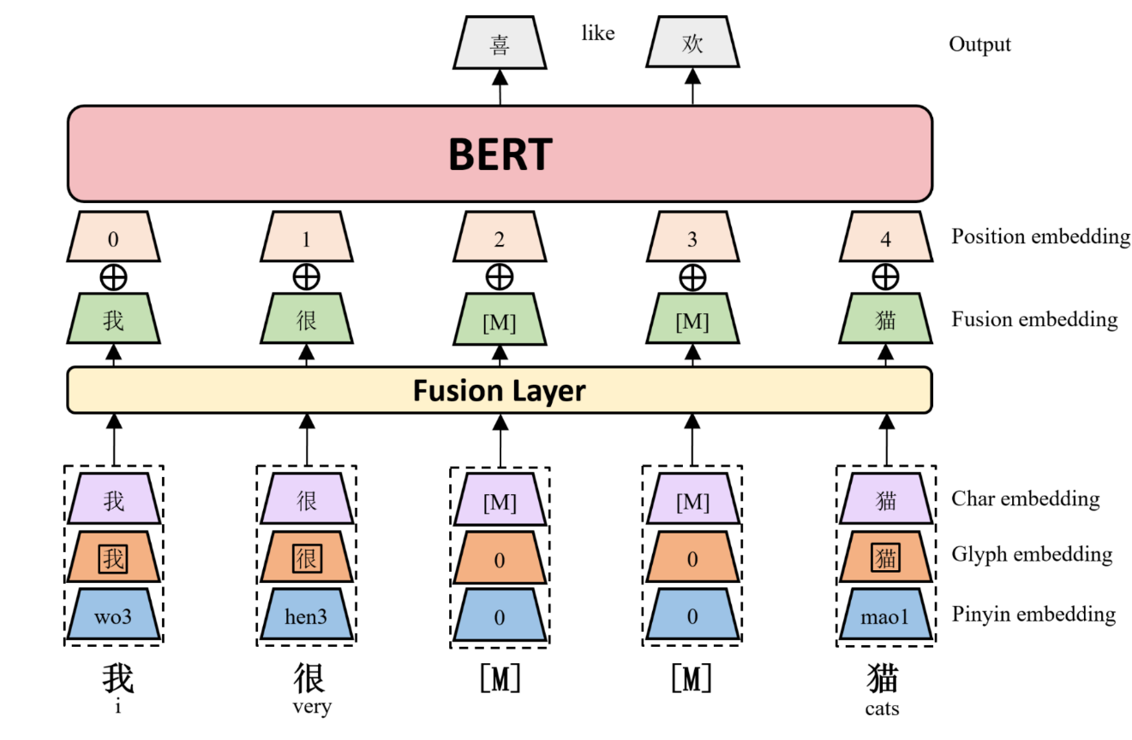
ChineseBERT leverages the glyph and pinyin information of Chinese characters to enhance the model's ability of capturing context semantics from surface character forms and disambiguating polyphonic characters in Chinese.
Download
We provide pre-trained ChineseBERT models in Pytorch version and followed huggingFace model format.
ChineseBERT-base:12-layer, 768-hidden, 12-heads, 147M parametersChineseBERT-large: 24-layer, 1024-hidden, 16-heads, 374M parameters
Our model can be downloaded here:
| Model | Model Hub | Size |
|---|---|---|
ChineseBERT-base |
Pytorch | 564M |
ChineseBERT-large |
Pytorch | 1.4G |
Note: The model hub contains model, fonts and pinyin config files.
Quick tour
We train our model with Huggingface, so the model can be easily loaded.
Download ChineseBERT model and save at [CHINESEBERT_PATH].
Here is a quick tour to load our model.
>>> from models.modeling_glycebert import GlyceBertForMaskedLM

>>> chinese_bert = GlyceBertForMaskedLM.from_pretrained([CHINESEBERT_PATH])
>>> print(chinese_bert)
The complete example can be find here: Masked word completion with ChineseBERT
Another example to get representation of a sentence:
>>> from datasets.bert_dataset import BertDataset
>>> from models.modeling_glycebert import GlyceBertModel

>>> tokenizer = BertDataset([CHINESEBERT_PATH])
>>> chinese_bert = GlyceBertModel.from_pretrained([CHINESEBERT_PATH])
>>> sentence = '我喜欢猫'

>>> input_ids, pinyin_ids = tokenizer.tokenize_sentence(sentence)
>>> length = input_ids.shape[0]
>>> input_ids = input_ids.view(1, length)
>>> pinyin_ids = pinyin_ids.view(1, length, 8)
>>> output_hidden = chinese_bert.forward(input_ids, pinyin_ids)[0]
>>> print(output_hidden)
tensor([[[ 0.0287, -0.0126,  0.0389,  ...,  0.0228, -0.0677, -0.1519],
         [ 0.0144, -0.2494, -0.1853,  ...,  0.0673,  0.0424, -0.1074],
         [ 0.0839, -0.2989, -0.2421,  ...,  0.0454, -0.1474, -0.1736],
         [-0.0499, -0.2983, -0.1604,  ..., -0.0550, -0.1863,  0.0226],
         [ 0.1428, -0.0682, -0.1310,  ..., -0.1126,  0.0440, -0.1782],
         [ 0.0287, -0.0126,  0.0389,  ...,  0.0228, -0.0677, -0.1519]]],
       grad_fn=)
The complete code can be find HERE
Experiments
ChnSetiCorp
ChnSetiCorp is a dataset for sentiment analysis.
Evaluation Metrics: Accuracy
| Model | Dev | Test |
|---|---|---|
| ERNIE | 95.4 | 95.5 |
| BERT | 95.1 | 95.4 |
| BERT-wwm | 95.4 | 95.3 |
| RoBERTa | 95.0 | 95.6 |
| MacBERT | 95.2 | 95.6 |
| ChineseBERT | 95.6 | 95.7 |
| ---- | ---- | |
| RoBERTa-large | 95.8 | 95.8 |
| MacBERT-large | 95.7 | 95.9 |
| ChineseBERT-large | 95.8 | 95.9 |
Training details and code can be find HERE
THUCNews
THUCNews contains news in 10 categories.
Evaluation Metrics: Accuracy
| Model | Dev | Test |
|---|---|---|
| ERNIE | 95.4 | 95.5 |
| BERT | 95.1 | 95.4 |
| BERT-wwm | 95.4 | 95.3 |
| RoBERTa | 95.0 | 95.6 |
| MacBERT | 95.2 | 95.6 |
| ChineseBERT | 95.6 | 95.7 |
| ---- | ---- | |
| RoBERTa-large | 95.8 | 95.8 |
| MacBERT-large | 95.7 | 95.9 |
| ChineseBERT-large | 95.8 | 95.9 |
Training details and code can be find HERE
XNLI
XNLI is a dataset for natural language inference.
Evaluation Metrics: Accuracy
| Model | Dev | Test |
|---|---|---|
| ERNIE | 79.7 | 78.6 |
| BERT | 79.0 | 78.2 |
| BERT-wwm | 79.4 | 78.7 |
| RoBERTa | 80.0 | 78.8 |
| MacBERT | 80.3 | 79.3 |
| ChineseBERT | 80.5 | 79.6 |
| ---- | ---- | |
| RoBERTa-large | 82.1 | 81.2 |
| MacBERT-large | 82.4 | 81.3 |
| ChineseBERT-large | 82.7 | 81.6 |
Training details and code can be find HERE
BQ
BQ Corpus is a sentence pair matching dataset.
Evaluation Metrics: Accuracy
| Model | Dev | Test |
|---|---|---|
| ERNIE | 86.3 | 85.0 |
| BERT | 86.1 | 85.2 |
| BERT-wwm | 86.4 | 85.3 |
| RoBERTa | 86.0 | 85.0 |
| MacBERT | 86.0 | 85.2 |
| ChineseBERT | 86.4 | 85.2 |
| ---- | ---- | |
| RoBERTa-large | 86.3 | 85.8 |
| MacBERT-large | 86.2 | 85.6 |
| ChineseBERT-large | 86.5 | 86.0 |
Training details and code can be find HERE
LCQMC
LCQMC Corpus is a sentence pair matching dataset.
Evaluation Metrics: Accuracy
| Model | Dev | Test |
|---|---|---|
| ERNIE | 89.8 | 87.2 |
| BERT | 89.4 | 87.0 |
| BERT-wwm | 89.6 | 87.1 |
| RoBERTa | 89.0 | 86.4 |
| MacBERT | 89.5 | 87.0 |
| ChineseBERT | 89.8 | 87.4 |
| ---- | ---- | |
| RoBERTa-large | 90.4 | 87.0 |
| MacBERT-large | 90.6 | 87.6 |
| ChineseBERT-large | 90.5 | 87.8 |
Training details and code can be find HERE
TNEWS
TNEWS is a 15-class short news text classification dataset.
Evaluation Metrics: Accuracy
| Model | Dev | Test |
|---|---|---|
| ERNIE | 58.24 | 58.33 |
| BERT | 56.09 | 56.58 |
| BERT-wwm | 56.77 | 56.86 |
| RoBERTa | 57.51 | 56.94 |
| ChineseBERT | 58.64 | 58.95 |
| ---- | ---- | |
| RoBERTa-large | 58.32 | 58.61 |
| ChineseBERT-large | 59.06 | 59.47 |
Training details and code can be find HERE
CMRC
CMRC is a machin reading comprehension task dataset.
Evaluation Metrics: EM
| Model | Dev | Test |
|---|---|---|
| ERNIE | 66.89 | 74.70 |
| BERT | 66.77 | 71.60 |
| BERT-wwm | 66.96 | 73.95 |
| RoBERTa | 67.89 | 75.20 |
| MacBERT | - | - |
| ChineseBERT | 67.95 | 95.7 |
| ---- | ---- | |
| RoBERTa-large | 70.59 | 77.95 |
| ChineseBERT-large | 70.70 | 78.05 |
Training details and code can be find HERE
OntoNotes
OntoNotes 4.0 is a Chinese named entity recognition dataset and contains 18 named entity types.
Evaluation Metrics: Span-Level F1
| Model | Test Precision | Test Recall | Test F1 |
|---|---|---|---|
| BERT | 79.69 | 82.09 | 80.87 |
| RoBERTa | 80.43 | 80.30 | 80.37 |
| ChineseBERT | 80.03 | 83.33 | 81.65 |
| ---- | ---- | ---- | |
| RoBERTa-large | 80.72 | 82.07 | 81.39 |
| ChineseBERT-large | 80.77 | 83.65 | 82.18 |
Training details and code can be find HERE
Weibo is a Chinese named entity recognition dataset and contains 4 named entity types.
Evaluation Metrics: Span-Level F1
| Model | Test Precision | Test Recall | Test F1 |
|---|---|---|---|
| BERT | 67.12 | 66.88 | 67.33 |
| RoBERTa | 68.49 | 67.81 | 68.15 |
| ChineseBERT | 68.27 | 69.78 | 69.02 |
| ---- | ---- | ---- | |
| RoBERTa-large | 66.74 | 70.02 | 68.35 |
| ChineseBERT-large | 68.75 | 72.97 | 70.80 |
Training details and code can be find HERE
Contact
If you have any question about our paper/code/modal/data...
Please feel free to discuss through github issues or emails.
You can send email to [email protected] or [email protected]

 9 Aug 04, 2022
 77 Jan 05, 2023
 4.2k Jan 01, 2023
 1 Mar 20, 2022
 10 Dec 11, 2022
 90 Dec 01, 2022
 52 Nov 16, 2022
 331 Dec 28, 2022
 141 Dec 21, 2022
 16 Sep 11, 2021
 2 Nov 03, 2021
 80 Sep 17, 2022
 34 Dec 25, 2022
 17 Jan 13, 2022
 542 Jan 01, 2023
 27 Dec 13, 2022
 8 Feb 23, 2021
 10 Apr 04, 2022
 1.7k Dec 30, 2022
 3k Dec 31, 2022