Implementation for the paper SMPLicit: Topology-aware Generative Model for Clothed People (CVPR 2021)

Related tags

Deep LearningSMPLicit
Overview

SMPLicit: Topology-aware Generative Model for Clothed People
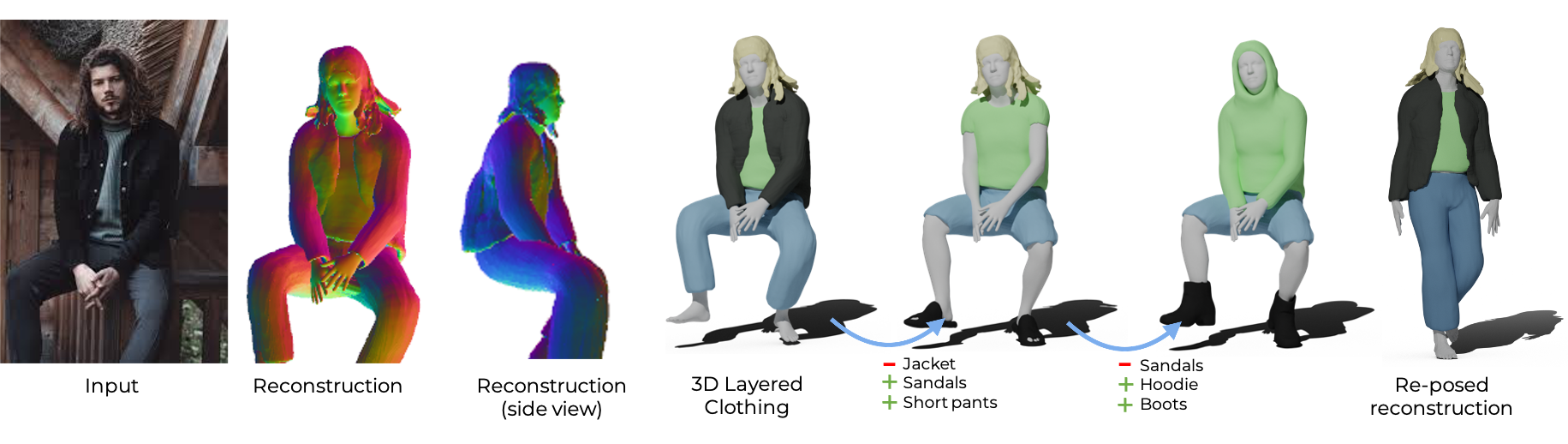
[Project] [arXiv]

License

Software Copyright License for non-commercial scientific research purposes. Please read carefully the terms and conditions and any accompanying documentation before you download and/or use the SMPLicit model, data and software, (the "Model & Software"), including 3D meshes, blend weights, blend shapes, textures, software, scripts, and animations. By downloading and/or using the Model & Software (including downloading, cloning, installing, and any other use of this github repository), you acknowledge that you have read these terms and conditions, understand them, and agree to be bound by them. If you do not agree with these terms and conditions, you must not download and/or use the Model & Software. Any infringement of the terms of this agreement will automatically terminate your rights under this License.

Installation

Follow these commands to install SMPLicit in your environment. The required libraries are standard, with the possible exception of Kaolin which requires a particular version to run with the current code.

  • git clone https://github.com/ecorona/SMPLicit

  • cd SMPLicit

  • Install the dependencies listed in requirements.txt:

    • pip install -r requirements.txt
  • In particular, we use Kaolin v0.1 (see installation command) which should be easy to install. However, if you want to use a later version, you might need to update the import to TriangleMesh in SMPLicit/SMPLicit.py

  • Download the SMPL model from here and place it in SMPLicit/utils/

To be able to import and use SMPLicit in another project, just use run python setup.py install in the main folder.

Usage

To check that everything is going well, run one of the test scripts under the examples folder. The first example will just show a simple T-Shirt on a standard shaped SMPL and visualize it using trimesh, to make sure everything is working.

cd examples/
python example.py

SMPLicit can represent clothes of different types, so the following example will also add lower-body clothes, hair and shoes into the example:

python example_fullbody.py

And finally one can interpolate between clothes of different types. For instance, moving between a jacket, tops, short or long sleeved T-Shirts. The following script will generate object meshes that represent these clothes and will be saved in interpolation/, below the main folder.

python interpolate.py

Citation

If you find the code useful, please cite:

@inproceedings{corona2021smplicit,
    Author = {Enric Corona and Albert Pumarola and Guillem Aleny{\`a} and Pons-Moll, Gerard and Moreno-Noguer, Francesc},
    Title = {SMPLicit: Topology-aware Generative Model for Clothed People},
    Year = {2021},
    booktitle = {CVPR},
}
GPU implementation of $k$-Nearest Neighbors and Shared-Nearest Neighbors

GPU implementation of kNN and SNN GPU implementation of $k$-Nearest Neighbors and Shared-Nearest Neighbors Supported by numba cuda and faiss library E

Hyeon Jeon 7 Nov 23, 2022
Load What You Need: Smaller Multilingual Transformers for Pytorch and TensorFlow 2.0.

Smaller Multilingual Transformers This repository shares smaller versions of multilingual transformers that keep the same representations offered by t

Geotrend 79 Dec 28, 2022
Azua - build AI algorithms to aid efficient decision-making with minimum data requirements.

Project Azua 0. Overview Many modern AI algorithms are known to be data-hungry, whereas human decision-making is much more efficient. The human can re

Microsoft 197 Jan 06, 2023
A deep learning library that makes face recognition efficient and effective

Distributed Arcface Training in Pytorch This is a deep learning library that makes face recognition efficient, and effective, which can train tens of

Sajjad Aemmi 10 Nov 23, 2021
Neuron class provides LNU (Linear Neural Unit), QNU (Quadratic Neural Unit), RBF (Radial Basis Function), MLP (Multi Layer Perceptron), MLP-ELM (Multi Layer Perceptron - Extreme Learning Machine) neurons learned with Gradient descent or LeLevenberg–Marquardt algorithm

Neuron class provides LNU (Linear Neural Unit), QNU (Quadratic Neural Unit), RBF (Radial Basis Function), MLP (Multi Layer Perceptron), MLP-ELM (Multi Layer Perceptron - Extreme Learning Machine) neu

Filip Molcik 38 Dec 17, 2022
An SMPC companion library for Syft

SyMPC A library that extends PySyft with SMPC support SyMPC /ˈsɪmpəθi/ is a library which extends PySyft ≥0.3 with SMPC support. It allows computing o

Arturo Marquez Flores 0 Oct 13, 2021
EgGateWayGetShell py脚本

EgGateWayGetShell_py 免责声明 由于传播、利用此文所提供的信息而造成的任何直接或者间接的后果及损失,均由使用者本人负责,作者不为此承担任何责任。 使用 python3 eg.py urls.txt 目标 title:锐捷网络-EWEB网管系统 port:4430 漏洞成因 ?p

榆木 61 Nov 09, 2022
Simple, but essential Bayesian optimization package

BayesO: A Bayesian optimization framework in Python Simple, but essential Bayesian optimization package. http://bayeso.org Online documentation Instal

Jungtaek Kim 74 Dec 05, 2022
Official Pytorch implementation of "Beyond Static Features for Temporally Consistent 3D Human Pose and Shape from a Video", CVPR 2021

TCMR: Beyond Static Features for Temporally Consistent 3D Human Pose and Shape from a Video Qualtitative result Paper teaser video Introduction This r

Hongsuk Choi 215 Jan 06, 2023
Code for the IJCAI 2021 paper "Structure Guided Lane Detection"

SGNet Project for the IJCAI 2021 paper "Structure Guided Lane Detection" Abstract Recently, lane detection has made great progress with the rapid deve

Jinming Su 27 Dec 08, 2022
FairyTailor: Multimodal Generative Framework for Storytelling

FairyTailor: Multimodal Generative Framework for Storytelling

Eden Bens 172 Dec 30, 2022
EgoNN: Egocentric Neural Network for Point Cloud Based 6DoF Relocalization at the City Scale

EgonNN: Egocentric Neural Network for Point Cloud Based 6DoF Relocalization at the City Scale Paper: EgoNN: Egocentric Neural Network for Point Cloud

19 Sep 20, 2022
Code repository for our paper "Learning to Generate Scene Graph from Natural Language Supervision" in ICCV 2021

Scene Graph Generation from Natural Language Supervision This repository includes the Pytorch code for our paper "Learning to Generate Scene Graph fro

Yiwu Zhong 64 Dec 24, 2022
Anti-Adversarially Manipulated Attributions for Weakly and Semi-Supervised Semantic Segmentation (CVPR 2021)

Anti-Adversarially Manipulated Attributions for Weakly and Semi-Supervised Semantic Segmentation Input Image Initial CAM Successive Maps with adversar

Jungbeom Lee 110 Dec 07, 2022
Bytedance Inc. 2.5k Jan 06, 2023
No-reference Image Quality Assessment(NIQA) Algorithms (BRISQUE, NIQE, PIQE, RankIQA, MetaIQA)

No-Reference Image Quality Assessment Algorithms No-reference Image Quality Assessment(NIQA) is a task of evaluating an image without a reference imag

Dae-Young Song 26 Jan 04, 2023
ReAct: Out-of-distribution Detection With Rectified Activations

ReAct: Out-of-distribution Detection With Rectified Activations This is the source code for paper ReAct: Out-of-distribution Detection With Rectified

38 Dec 05, 2022
Neural Style and MSG-Net

PyTorch-Style-Transfer This repo provides PyTorch Implementation of MSG-Net (ours) and Neural Style (Gatys et al. CVPR 2016), which has been included

Hang Zhang 904 Dec 21, 2022
Spectrum is an AI that uses machine learning to generate Rap song lyrics

Spectrum Spectrum is an AI that uses deep learning to generate rap song lyrics. View Demo Report Bug Request Feature Open In Colab About The Project S

39 Dec 16, 2022
GoodNews Everyone! Context driven entity aware captioning for news images

This is the code for a CVPR 2019 paper, called GoodNews Everyone! Context driven entity aware captioning for news images. Enjoy! Model preview: Huge T

117 Dec 19, 2022