Neural Scene Graphs for Dynamic Scene (CVPR 2021)
Overview

Neural Scene Graphs for Dynamic Scene (CVPR 2021)

alt text

Project Page | Paper

Julian Ost, Fahim Mannan, Nils Thuerey, Julian Knodt, Felix Heide

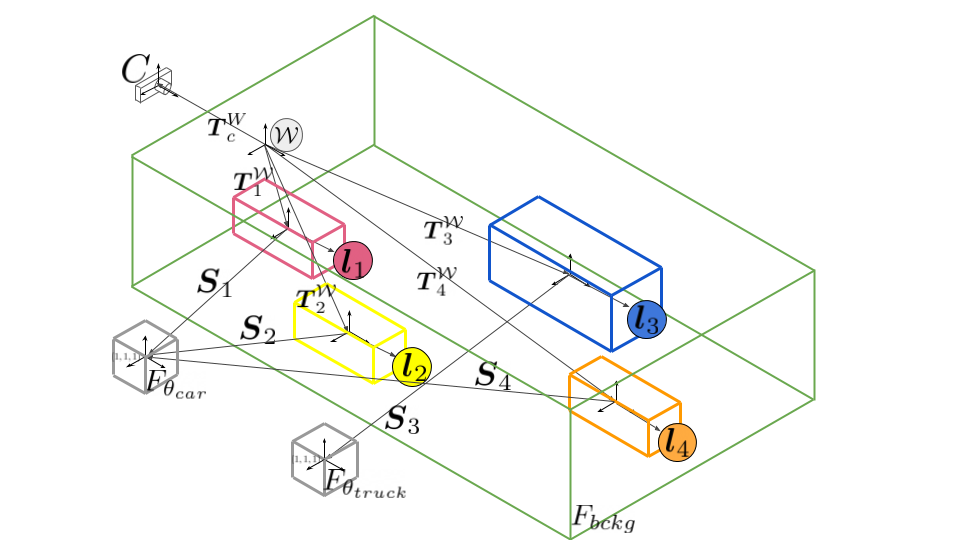
Implementation of Neural Scene Graphs, that optimizes multiple radiance fields to represent different objects and a static scene background. Learned representations can be rendered with novel object compositions and views.

Original repository forked from the Implementation of "NeRF: Neural Radiance Fields" by Mildenhall et al.: Original NeRF Implementation, original readme


Getting started

The whole script is currently optimized for the usage with Virtual KITTI 2 Dataset and KITTI

Quick Start

Train a Virtual KITTI 2 Scene

conda create -n neural_scene_graphs --file requirements.txt -c conda-forge -c menpo
conda activate neural_scene_graphs
cd neural-scene-graphs
bash download_virtual_kitti.sh
python main.py --config example_configs/config_vkitti2_Scene06.py
tensorboard --logdir=example_weights/summaries --port=6006

Render a pretrained KITTI Scene from a trained Scene Graph Models

Follow the instructions under data preparation to setup the KITTI dataset.

conda create -n neural_scene_graphs --file requirements.txt -c conda-forge -c menpo
conda activate neural_scene_graphs
cd neural-scene-graphs
bash download_weights_kitti.sh
python main.py --config example_configs/config_kitti_0006_example_render.py
tensorboard --logdir=example_weights/summaries --port=6006

Disclaimer: The codebase is optimized to run on larger GPU servers with a lot of free CPU memory. To test on local and low memory,

  1. Use chunk and netchunk in the config files to limit parallel computed rays and sampling points.

or

  1. resize and retrain with
--training_factor = 'downsampling factor'

or change to the desired factor in your config file.


Data Preperation

KITTI

  1. Get the KITTI MOT dataset, from which you need:
    1. Left color images
    2. Right color images
    3. GPS/IMU data
    4. Camera Calibration Files
    5. Training labels
  2. Extract everything to ./data/kitti and keep the data structure
  3. Neural Scene Graphs is well tested and published on real front-facing scenarios with only small movements along the camera viewing direction. We therefore prepared selected config files for KITTI Scenes (0001, 0002, 0006)

Virtual KITTI 2

bash ./download_virtual_kitti.sh

Training

To optimize models on a subsequence of Virtual KITTI 2 or KITTI, create the environment, download the data set (1.2) and optimize the (pre-trained) background and object models together:

conda create -n neural_scene_graphs --file requirements.txt -c conda-forge -c menpo
conda activate neural_scene_graphs

vkitti2 example:

python main.py --config example_configs/config_vkitti2_Scene06.txt
tensorboard --logdir=example_weights/summaries --port=6006

KITTI example:

python main.py --config example_configs/config_kitti_0006_example_train.txt
tensorboard --logdir=example_weights/summaries --port=6006

Rendering a Sequence

Render a pretrained KITTI sequence

bash download_weights_kitti.sh
python main.py --config example_configs/config_kitti_0006_example_render.txt

To render a pre-trained download the weights or use your own model.

bash download_weights_kitti.sh

To make a full render pass over all selected images (between the first and last frame) run the provided config with 'render_only=True'.

  • To render only the outputs of the static background node use 'bckg_only=True'
  • for all dynamic parts set 'obj_only=True' & 'white_bkgd=True'
python main.py --config example_configs/config_kitti_0006_example_render.txt

Citation

@InProceedings{Ost_2021_CVPR,
    author    = {Ost, Julian and Mannan, Fahim and Thuerey, Nils and Knodt, Julian and Heide, Felix},
    title     = {Neural Scene Graphs for Dynamic Scenes},
    booktitle = {Proceedings of the IEEE/CVF Conference on Computer Vision and Pattern Recognition (CVPR)},
    month     = {June},
    year      = {2021},
    pages     = {2856-2865}
}
Web service for facial landmark detection, head pose estimation, facial action unit recognition, and eye-gaze estimation based on OpenFace 2.0

OpenGaze: Web Service for OpenFace Facial Behaviour Analysis Toolkit Overview OpenFace is a fantastic tool intended for computer vision and machine le

Sayom Shakib 4 Nov 03, 2022
Official Code for "Constrained Mean Shift Using Distant Yet Related Neighbors for Representation Learning"

CMSF Official Code for "Constrained Mean Shift Using Distant Yet Related Neighbors for Representation Learning" Requirements Python = 3.7.6 PyTorch

4 Nov 25, 2022
Ranking Models in Unlabeled New Environments (iccv21)

Ranking Models in Unlabeled New Environments Prerequisites This code uses the following libraries Python 3.7 NumPy PyTorch 1.7.0 + torchivision 0.8.1

14 Dec 17, 2021
Code repository for the paper Computer Vision User Entity Behavior Analytics

Computer Vision User Entity Behavior Analytics Code repository for "Computer Vision User Entity Behavior Analytics" Code Description dataset.csv As di

Sameer Khanna 2 Aug 20, 2022
Using some basic methods to show linkages and transformations of robotic arms

roboticArmVisualizer Python GUI application to create custom linkages and adjust joint angles. In the future, I plan to add 2d inverse kinematics solv

Sandesh Banskota 1 Nov 19, 2021
DeiT: Data-efficient Image Transformers

DeiT: Data-efficient Image Transformers This repository contains PyTorch evaluation code, training code and pretrained models for DeiT (Data-Efficient

Facebook Research 3.2k Jan 06, 2023
Open source code for Paper "A Co-Interactive Transformer for Joint Slot Filling and Intent Detection"

A Co-Interactive Transformer for Joint Slot Filling and Intent Detection This repository contains the PyTorch implementation of the paper: A Co-Intera

67 Dec 05, 2022
An Straight Dilated Network with Wavelet for image Deblurring

SDWNet: A Straight Dilated Network with Wavelet Transformation for Image Deblurring(offical) 1. Introduction This repo is not only used for our paper(

FlyEgle 41 Jan 04, 2023
Official Repo for ICCV2021 Paper: Learning to Regress Bodies from Images using Differentiable Semantic Rendering

[ICCV2021] Learning to Regress Bodies from Images using Differentiable Semantic Rendering Getting Started DSR has been implemented and tested on Ubunt

Sai Kumar Dwivedi 83 Nov 27, 2022
Official Keras Implementation for UNet++ in IEEE Transactions on Medical Imaging and DLMIA 2018

UNet++: A Nested U-Net Architecture for Medical Image Segmentation UNet++ is a new general purpose image segmentation architecture for more accurate i

Zongwei Zhou 1.8k Jan 07, 2023
BOOKSUM: A Collection of Datasets for Long-form Narrative Summarization

BOOKSUM: A Collection of Datasets for Long-form Narrative Summarization Authors: Wojciech Kryściński, Nazneen Rajani, Divyansh Agarwal, Caiming Xiong,

Salesforce 125 Dec 31, 2022
Automatic number plate recognition using tech: Yolo, OCR, Scene text detection, scene text recognation, flask, torch

Automatic Number Plate Recognition Automatic Number Plate Recognition (ANPR) is the process of reading the characters on the plate with various optica

Meftun AKARSU 52 Dec 22, 2022
Official implementation for "Low-light Image Enhancement via Breaking Down the Darkness"

Low-light Image Enhancement via Breaking Down the Darkness by Qiming Hu, Xiaojie Guo. 1. Dependencies Python3 PyTorch=1.0 OpenCV-Python, TensorboardX

Qiming Hu 30 Jan 01, 2023
Uncertainty Estimation via Response Scaling for Pseudo-mask Noise Mitigation in Weakly-supervised Semantic Segmentation

Uncertainty Estimation via Response Scaling for Pseudo-mask Noise Mitigation in Weakly-supervised Semantic Segmentation Introduction This is a PyTorch

XMed-Lab 30 Sep 23, 2022
Rethinking Space-Time Networks with Improved Memory Coverage for Efficient Video Object Segmentation

STCN Rethinking Space-Time Networks with Improved Memory Coverage for Efficient Video Object Segmentation Ho Kei Cheng, Yu-Wing Tai, Chi-Keung Tang [a

Rex Cheng 456 Dec 12, 2022
Code for Greedy Gradient Ensemble for Visual Question Answering (ICCV 2021, Oral)

Greedy Gradient Ensemble for De-biased VQA Code release for "Greedy Gradient Ensemble for Robust Visual Question Answering" (ICCV 2021, Oral). GGE can

21 Jun 29, 2022
Earth Vision Foundation

EVer - A Library for Earth Vision Researcher EVer is a Pytorch-based Python library to simplify the training and inference of the deep learning model.

Zhuo Zheng 34 Nov 26, 2022
Interactive Visualization to empower domain experts to align ML model behaviors with their knowledge.

An interactive visualization system designed to helps domain experts responsibly edit Generalized Additive Models (GAMs). For more information, check

InterpretML 83 Jan 04, 2023
Spatial Single-Cell Analysis Toolkit

Single-Cell Image Analysis Package Scimap is a scalable toolkit for analyzing spatial molecular data. The underlying framework is generalizable to spa

Laboratory of Systems Pharmacology @ Harvard 30 Nov 08, 2022
Recognize Handwritten Digits using Deep Learning on the browser itself.

MNIST on the Web An attempt to predict MNIST handwritten digits from my PyTorch model from the browser (client-side) and not from the server, with the

Harjyot Bagga 7 May 28, 2022