Implementation of Convolutional LSTM in PyTorch.

Overview

ConvLSTM_pytorch

This file contains the implementation of Convolutional LSTM in PyTorch made by me and DavideA.

We started from this implementation and heavily refactored it add added features to match our needs.

Please note that in this repository we implement the following dynamics: CLSTM_dynamics
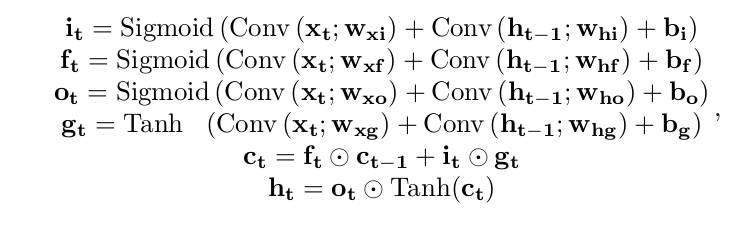
which is a bit different from the one in the original paper.

How to Use

The ConvLSTM module derives from nn.Module so it can be used as any other PyTorch module.

The ConvLSTM class supports an arbitrary number of layers. In this case, it can be specified the hidden dimension (that is, the number of channels) and the kernel size of each layer. In the case more layers are present but a single value is provided, this is replicated for all the layers. For example, in the following snippet each of the three layers has a different hidden dimension but the same kernel size.

Example usage:

model = ConvLSTM(input_dim=channels,
                 hidden_dim=[64, 64, 128],
                 kernel_size=(3, 3),
                 num_layers=3,
                 batch_first=True
                 bias=True,
                 return_all_layers=False)

TODO (in progress...)

  • Comment code
  • Add docs
  • Add example usage on a toy problem
  • Implement stateful mechanism
  • ...

Disclaimer

This is still a work in progress and is far from being perfect: if you find any bug please don't hesitate to open an issue.

Owner
Andrea Palazzi
Senior Deep Learning Engineer @ Nomitri - Computer Vision PhD
Andrea Palazzi
Lunar is a neural network aimbot that uses real-time object detection accelerated with CUDA on Nvidia GPUs.

Lunar Lunar is a neural network aimbot that uses real-time object detection accelerated with CUDA on Nvidia GPUs. About Lunar can be modified to work

Zeyad Mansour 276 Jan 07, 2023
Which Style Makes Me Attractive? Interpretable Control Discovery and Counterfactual Explanation on StyleGAN

Interpretable Control Exploration and Counterfactual Explanation (ICE) on StyleGAN Which Style Makes Me Attractive? Interpretable Control Discovery an

Bo Li 11 Dec 01, 2022
A Simple Key-Value Data-store written in Python

mercury-db This is a File Based Key-Value Datastore that supports basic CRUD (Create, Read, Update, Delete) operations developed using Python. The dat

Vaidhyanathan S M 1 Jan 09, 2022
TilinGNN: Learning to Tile with Self-Supervised Graph Neural Network (SIGGRAPH 2020)

TilinGNN: Learning to Tile with Self-Supervised Graph Neural Network (SIGGRAPH 2020) About The goal of our research problem is illustrated below: give

59 Dec 09, 2022
The official PyTorch implementation of the paper: *Xili Dai, Xiaojun Yuan, Haigang Gong, Yi Ma. "Fully Convolutional Line Parsing." *.

F-Clip — Fully Convolutional Line Parsing This repository contains the official PyTorch implementation of the paper: *Xili Dai, Xiaojun Yuan, Haigang

Xili Dai 115 Dec 28, 2022
(CVPR 2021) PAConv: Position Adaptive Convolution with Dynamic Kernel Assembling on Point Clouds

PAConv: Position Adaptive Convolution with Dynamic Kernel Assembling on Point Clouds by Mutian Xu*, Runyu Ding*, Hengshuang Zhao, and Xiaojuan Qi. Int

CVMI Lab 228 Dec 25, 2022
Rule based classification A hotel s customers dataset

Rule-based-classification-A-hotel-s-customers-dataset- Aim: Categorize new customers by segment and predict how much revenue they can generate This re

Şebnem 4 Jan 02, 2022
MOOSE (Multi-organ objective segmentation) a data-centric AI solution that generates multilabel organ segmentations to facilitate systemic TB whole-person research

MOOSE (Multi-organ objective segmentation) a data-centric AI solution that generates multilabel organ segmentations to facilitate systemic TB whole-person research.The pipeline is based on nn-UNet an

QIMP team 30 Jan 01, 2023
Personalized Federated Learning using Pytorch (pFedMe)

Personalized Federated Learning with Moreau Envelopes (NeurIPS 2020) This repository implements all experiments in the paper Personalized Federated Le

Charlie Dinh 226 Dec 30, 2022
Implementation of QuickDraw - an online game developed by Google, combined with AirGesture - a simple gesture recognition application

QuickDraw - AirGesture Introduction Here is my python source code for QuickDraw - an online game developed by google, combined with AirGesture - a sim

Viet Nguyen 89 Dec 18, 2022
Rust bindings for the C++ api of PyTorch.

tch-rs Rust bindings for the C++ api of PyTorch. The goal of the tch crate is to provide some thin wrappers around the C++ PyTorch api (a.k.a. libtorc

Laurent Mazare 2.3k Dec 30, 2022
A Distributional Approach To Controlled Text Generation

A Distributional Approach To Controlled Text Generation This is the repository code for the ICLR 2021 paper "A Distributional Approach to Controlled T

NAVER 102 Jan 07, 2023
This repository contains the exercises and its solution contained in the book "An Introduction to Statistical Learning" in python.

An-Introduction-to-Statistical-Learning This repository contains the exercises and its solution contained in the book An Introduction to Statistical L

2.1k Jan 02, 2023
This is the official implementation of the paper "Object Propagation via Inter-Frame Attentions for Temporally Stable Video Instance Segmentation".

ObjProp Introduction This is the official implementation of the paper "Object Propagation via Inter-Frame Attentions for Temporally Stable Video Insta

Anirudh S Chakravarthy 6 May 03, 2022
Identify the emotion of multiple speakers in an Audio Segment

MevonAI - Speech Emotion Recognition Identify the emotion of multiple speakers in a Audio Segment Report Bug · Request Feature Try the Demo Here Table

Suyash More 110 Dec 03, 2022
An implementation of the WHATWG URL Standard in JavaScript

whatwg-url whatwg-url is a full implementation of the WHATWG URL Standard. It can be used standalone, but it also exposes a lot of the internal algori

314 Dec 28, 2022
From this paper "SESNet: A Semantically Enhanced Siamese Network for Remote Sensing Change Detection"

SESNet for remote sensing image change detection It is the implementation of the paper: "SESNet: A Semantically Enhanced Siamese Network for Remote Se

1 May 24, 2022
Our implementation used for the MICCAI 2021 FLARE Challenge titled 'Efficient Multi-Organ Segmentation Using SpatialConfiguartion-Net with Low GPU Memory Requirements'.

Efficient Multi-Organ Segmentation Using SpatialConfiguartion-Net with Low GPU Memory Requirements Our implementation used for the MICCAI 2021 FLARE C

Franz Thaler 3 Sep 27, 2022
Graph Analysis From Scratch

Graph Analysis From Scratch Goal In this notebook we wanted to implement some functionalities to analyze a weighted graph only by using algorithms imp

Arturo Ghinassi 0 Sep 17, 2022