Pytorch implementation of Make-A-Scene: Scene-Based Text-to-Image Generation with Human Priors

Overview

Make-A-Scene - PyTorch

Pytorch implementation (inofficial) of Make-A-Scene: Scene-Based Text-to-Image Generation with Human Priors (https://arxiv.org/pdf/2203.13131.pdf)

results Figure 1. from paper

Note: this is work in progress.

Everyone is happily invited to contribute --> Discord Channel: https://discord.gg/hCRMGRZkC6

We would love to open-source a trained model. The model is a billion parameter model. Training it requires a lot of compute. If anyone can provide computational resources, let us know.

Paper Description:

Make-A-Scene modifies the VQGAN framework. It makes heavy use of using semantic segmentation maps for extra conditioning. This enables more influence on the generation process. Morever, it also conditions on text. The main improvements are the following:

  1. Segmentation condition: separate VQVAE is trained (VQ-SEG) + loss modified to a weighted binary cross entropy. (3.4)
  2. VQGAN training (VQ-IMG) is extended by Face-Loss & Object-Loss (3.3 & 3.5)
  3. Classifier Guidance for the autoregressive transformer (3.7)

Training Pipeline
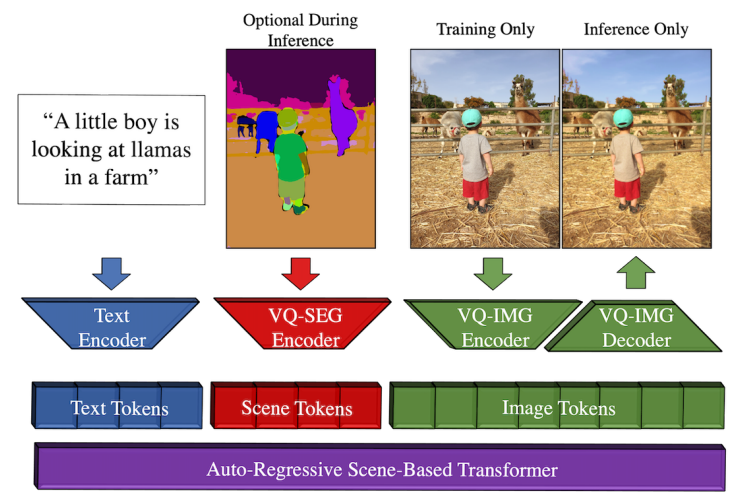
results Figure 6. from paper

What needs to be done?

Refer to the different folders to see details.

Citation

@misc{https://doi.org/10.48550/arxiv.2203.13131,
  doi = {10.48550/ARXIV.2203.13131},
  url = {https://arxiv.org/abs/2203.13131},
  author = {Gafni, Oran and Polyak, Adam and Ashual, Oron and Sheynin, Shelly and Parikh, Devi and Taigman, Yaniv},
  title = {Make-A-Scene: Scene-Based Text-to-Image Generation with Human Priors},
  publisher = {arXiv},
  year = {2022},
  copyright = {arXiv.org perpetual, non-exclusive license}
}
Owner
Casual GAN Papers
Generative AI community | Popular ML paper summaries | Generative Art | Paper Implementations
Casual GAN Papers
Python scripts form performing stereo depth estimation using the CoEx model in ONNX.

ONNX-CoEx-Stereo-Depth-estimation Python scripts form performing stereo depth estimation using the CoEx model in ONNX. Stereo depth estimation on the

Ibai Gorordo 8 Dec 29, 2022
1st place solution to the Satellite Image Change Detection Challenge hosted by SenseTime

1st place solution to the Satellite Image Change Detection Challenge hosted by SenseTime

Lihe Yang 209 Jan 01, 2023
A set of tools for Namebase and HNS

HNS-TOOLS A set of tools for Namebase and HNS To install: pip install -r requirements.txt To run: py main.py My Namebase referral code: http://namebas

RunDavidMC 7 Apr 08, 2022
Pytorch reimplementation of the Mixer (MLP-Mixer: An all-MLP Architecture for Vision)

MLP-Mixer Pytorch reimplementation of Google's repository for the MLP-Mixer (Not yet updated on the master branch) that was released with the paper ML

Eunkwang Jeon 18 Dec 08, 2022
Implementation of our paper 'RESA: Recurrent Feature-Shift Aggregator for Lane Detection' in AAAI2021.

RESA PyTorch implementation of the paper "RESA: Recurrent Feature-Shift Aggregator for Lane Detection". Our paper has been accepted by AAAI2021. Intro

137 Jan 02, 2023
Implementation of "StrengthNet: Deep Learning-based Emotion Strength Assessment for Emotional Speech Synthesis"

StrengthNet Implementation of "StrengthNet: Deep Learning-based Emotion Strength Assessment for Emotional Speech Synthesis" https://arxiv.org/abs/2110

RuiLiu 65 Dec 20, 2022
Dynamic Capacity Networks using Tensorflow

Dynamic Capacity Networks using Tensorflow Dynamic Capacity Networks (DCN; http://arxiv.org/abs/1511.07838) implementation using Tensorflow. DCN reduc

Taeksoo Kim 8 Feb 23, 2021
Deep Anomaly Detection with Outlier Exposure (ICLR 2019)

Outlier Exposure This repository contains the essential code for the paper Deep Anomaly Detection with Outlier Exposure (ICLR 2019). Requires Python 3

Dan Hendrycks 464 Dec 27, 2022
This repo generates the training data and the model for Morpheus-Deblend

Morpheus-Deblend This repo generates the training data and the model for Morpheus-Deblend. This is the active development repo for the project and as

Ryan Hausen 2 Apr 18, 2022
Synthesize photos from PhotoDNA using machine learning 🌱

Ribosome Synthesize photos from PhotoDNA. See the blog post for more information. Installation Dependencies You can install Python dependencies using

Anish Athalye 112 Nov 23, 2022
Food Drinks and groceries Images Multi Lingual (FooDI-ML) dataset.

Food Drinks and groceries Images Multi Lingual (FooDI-ML) dataset.

41 Jan 04, 2023
Complex-Valued Neural Networks (CVNN)Complex-Valued Neural Networks (CVNN)

Complex-Valued Neural Networks (CVNN) Done by @NEGU93 - J. Agustin Barrachina Using this library, the only difference with a Tensorflow code is that y

youceF 1 Nov 12, 2021
A collection of implementations of deep domain adaptation algorithms

Deep Transfer Learning on PyTorch This is a PyTorch library for deep transfer learning. We divide the code into two aspects: Single-source Unsupervise

Yongchun Zhu 647 Jan 03, 2023
Implementation of SE3-Transformers for Equivariant Self-Attention, in Pytorch.

SE3 Transformer - Pytorch Implementation of SE3-Transformers for Equivariant Self-Attention, in Pytorch. May be needed for replicating Alphafold2 resu

Phil Wang 207 Dec 23, 2022
An open source AutoML toolkit for automate machine learning lifecycle, including feature engineering, neural architecture search, model compression and hyper-parameter tuning.

NNI Doc | 简体中文 NNI (Neural Network Intelligence) is a lightweight but powerful toolkit to help users automate Feature Engineering, Neural Architecture

Microsoft 12.4k Dec 31, 2022
MRQy is a quality assurance and checking tool for quantitative assessment of magnetic resonance imaging (MRI) data.

Front-end View Backend View Table of Contents Description Prerequisites Running Basic Information Measurements User Interface Feedback and usage Descr

Center for Computational Imaging and Personalized Diagnostics 58 Dec 02, 2022
Lucid library adapted for PyTorch

Lucent PyTorch + Lucid = Lucent The wonderful Lucid library adapted for the wonderful PyTorch! Lucent is not affiliated with Lucid or OpenAI's Clarity

Lim Swee Kiat 520 Dec 26, 2022
MicRank is a Learning to Rank neural channel selection framework where a DNN is trained to rank microphone channels.

MicRank: Learning to Rank Microphones for Distant Speech Recognition Application Scenario Many applications nowadays envision the presence of multiple

Samuele Cornell 20 Nov 10, 2022
Gradient-free global optimization algorithm for multidimensional functions based on the low rank tensor train format

ttopt Description Gradient-free global optimization algorithm for multidimensional functions based on the low rank tensor train (TT) format and maximu

5 May 23, 2022
Pseudo lidar - (CVPR 2019) Pseudo-LiDAR from Visual Depth Estimation: Bridging the Gap in 3D Object Detection for Autonomous Driving

Pseudo-LiDAR from Visual Depth Estimation: Bridging the Gap in 3D Object Detection for Autonomous Driving This paper has been accpeted by Conference o

Yan Wang 881 Dec 27, 2022