Invertible Conditional GANs
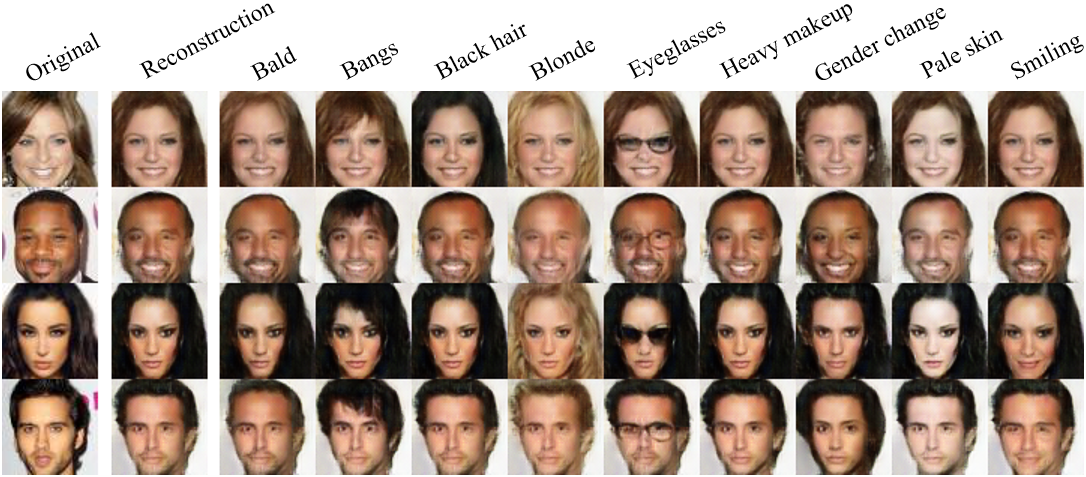
This is the implementation of the IcGAN model proposed in our paper:
Invertible Conditional GANs for image editing. November 2016.
This paper is a summarized and updated version of my master thesis, which you can find here:
Master thesis: Invertible Conditional Generative Adversarial Networks. September 2016.
The baseline used is the Torch implementation of the DCGAN by Radford et al.
Requisites
Please refer to DCGAN torch repository to know the requirements and dependencies to run the code. Additionally, you will need to install the threads and optnet package:
luarocks install threads
luarocks install optnet
In order to interactively display the results, follow these steps.
1. Training the model

The IcGAN is trained in four steps.
- Train the generator.
- Create a dataset of generated images with the generator.
- Train the encoder Z to map an image x to a latent representation z with the dataset generated images.
- Train the encoder Y to map an image x to a conditional information vector y with the dataset of real images.
All the parameters of the training phase are located in cfg/mainConfig.lua.
There is already a pre-trained model for CelebA available in case you want to skip the training part. Here you can find instructions on how to use it.
1.1 Train with a face dataset: CelebA
Note: for speed purposes, the whole dataset will be loaded into RAM during training time, which requires about 10 GB of RAM. Therefore, 12 GB of RAM is a minimum requirement. Also, the dataset will be stored as a tensor to load it faster, make sure that you have around 25 GB of free space.
Preprocess
mkdir celebA; cd celebA
Download img_align_celeba.zip here under the link "Align&Cropped Images". Also, you will need to download list_attr_celeba.txt from the same link, which is found under Anno folder.
unzip img_align_celeba.zip; cd ..
DATA_ROOT=celebA th data/preprocess_celebA.lua
Now move list_attr_celeba.txt to celebA folder.
mv list_attr_celeba.txt celebA
Training
-
Conditional GAN: parameters are already configured to run CelebA (dataset=celebA, dataRoot=celebA).
th trainGAN.lua
-
Generate encoder dataset:
net=[GENERATOR_PATH] outputFolder=celebA/genDataset/ samples=182638 th data/generateEncoderDataset.lua
(GENERATOR_PATH example: checkpoints/celebA_25_net_G.t7)
-
Train encoder Z:
datasetPath=celebA/genDataset/ type=Z th trainEncoder.lua -
Train encoder Y:
datasetPath=celebA/ type=Y th trainEncoder.lua
1.2 Train with a digit dataset: MNIST
Preprocess
Download MNIST as a luarocks package: luarocks install mnist
Training
-
Conditional GAN:
name=mnist dataset=mnist dataRoot=mnist th trainGAN.lua
-
Generate encoder dataset:
net=[GENERATOR_PATH] outputFolder=mnist/genDataset/ samples=60000 th data/generateEncoderDataset.lua
(GENERATOR_PATH example: checkpoints/mnist_25_net_G.t7)
-
Train encoder Z:
datasetPath=mnist/genDataset/ type=Z th trainEncoder.lua -
Train encoder Y:
datasetPath=mnist type=Y th trainEncoder.lua
2 Pre-trained CelebA model:
CelebA model is available for download here. The file includes the generator and both encoders (encoder Z and encoder Y).
3. Visualize the results
For visualizing the results you will need an already trained IcGAN (i.e. a generator and two encoders). The parameters for generating results are in cfg/generateConfig.lua.
3.1 Reconstruct and modify real images

decNet=celeba_24_G.t7 encZnet=celeba_encZ_7.t7 encYnet=celeba_encY_5.t7 loadPath=[PATH_TO_REAL_IMAGES] th generation/reconstructWithVariations.lua
3.2 Swap attributes

Swap the attribute information between two pairs of faces.
decNet=celeba_24_G.t7 encZnet=celeba_encZ_7.t7 encYnet=celeba_encY_5.t7 im1Path=[IM1] im2Path=[IM2] th generation/attributeTransfer.lua
3.3 Interpolate between faces

decNet=celeba_24_G.t7 encZnet=celeba_encZ_7.t7 encYnet=celeba_encY_5.t7 im1Path=[IM1] im2Path=[IM2] th generation/interpolate.lua
Do you like or use our work? Please cite us as
@inproceedings{Perarnau2016,
  author    = {Guim Perarnau and
               Joost van de Weijer and
               Bogdan Raducanu and
               Jose M. \'Alvarez},
  title     = {{Invertible Conditional GANs for image editing}},
  booktitle   = {NIPS Workshop on Adversarial Training},
  year      = {2016},
}

 846 Jan 04, 2023
 16 Jan 03, 2023
 187 Oct 01, 2022
 24 Sep 08, 2022
 131 Dec 13, 2022
 49 Dec 01, 2022
 5 Nov 19, 2022
 41 Jan 04, 2023
 1.3k Jan 01, 2023
 12.6k Jan 09, 2023
 2.4k Jan 04, 2023
 115 Jan 02, 2023
 2 Dec 08, 2022
 15.3k Jan 05, 2023
 81 Dec 27, 2022
 [email protected]">
38 Nov 22, 2022
[email protected]">
38 Nov 22, 2022
 115 Dec 28, 2022
 625 Oct 27, 2022
 370 Dec 29, 2022