当前位置:网站首页>QT reading and writing XML files (including source code + comments)
QT reading and writing XML files (including source code + comments)
2022-04-23 18:07:00 【Lao Wang who loves cooking】
One 、 Example XML The contents of the document
The following is the... Used in this article xml The content of the document
<?xml version="1.0" encoding="UTF-8"?>
<root>
    <childNode1 attruKey="attriVal">childNode1 Val</childNode1>
    <childNode2 attruKey="attriVal">
        <cChildNode1 shuxing1="1">cChildNode1 Val</cChildNode1>
        <cChildNode2 shuxing2="2">cChildNode2 Val</cChildNode2>
    </childNode2>
</root>
Two 、XML Writing files
Below is XML File written source code , The code contents are as follows :
- QDomDocument Object creation and xml Addition of file header
- Create a root node
- Create child nodes that contain attributes and node values
- Create more complex child nodes ( Contains attributes and third level nodes )
- write file
        // establish QDomDocument object
    QDomDocument xDoc;
    QDomProcessingInstruction inStruction;
    // write in xml The file header (xml Version information and coding information )
    inStruction = xDoc.createProcessingInstruction("xml","version=\"1.0\" encoding=\"UTF-8\"");
    xDoc.appendChild(inStruction);

    // Create a root node and add it to xDoc in
    QDomElement root = xDoc.createElement("root");
    xDoc.appendChild(root);

    // Create child nodes 1
    QDomElement childNode1 = xDoc.createElement("childNode1");
    // Is a child node childNode1 Set properties and property values
    childNode1.setAttribute("attruKey", "attriVal");
    //!  Is a child node childNode1 Add node value
    //!  establish QDomText Object and set its value
    QDomText nodeVal = xDoc.createTextNode("childNode1 Val");
    // Use QDomElement Object's nodes , To add a node value, you need to add QDomText object , Otherwise, the value may not be displayed
    childNode1.appendChild(nodeVal);
    // Put the child nodes 1 Add to the root node
    root.appendChild(childNode1);

    //!  Create a multi-level node childNode2

    // Create multi-level nodes 2
    QDomElement childNode2 = xDoc.createElement("childNode2");
    // It is a multi-level node childNode2 Set properties and property values
    childNode2.setAttribute("attruKey", "attriVal");
    // Create child nodes of multi-level nodes 1
    QDomElement cChildNode1 = xDoc.createElement("cChildNode1");
    // Set up cChildNode1 Properties and values of
    cChildNode1.setAttribute("shuxing1", 1);
    // Set up cChildNode1 Node value
    cChildNode1.appendChild(xDoc.createTextNode("cChildNode1 Val"));
    // take cChildNode1 Add nodes to multi-level nodes
    childNode2.appendChild(cChildNode1);

    // Create child nodes of multi-level nodes 2
    QDomElement cChildNode2 = xDoc.createElement("cChildNode2");
    // Set up cChildNode2 Properties and values of
    cChildNode2.setAttribute("shuxing2", 2);
    // Set up cChildNode2 Node value
    cChildNode2.appendChild(xDoc.createTextNode("cChildNode2 Val"));
    // take cChildNode2 Add nodes to multi-level nodes
    childNode2.appendChild(cChildNode2);

    // Multi level node childNode2 Add to the root node
    root.appendChild(childNode2);

    // Appoint xml File path
    QFile file("./xmlTest.xml");
    // Open as read-only , And will empty the contents of the file
    if(!file.open(QIODevice::WriteOnly | QIODevice::Truncate))
        return 0;
    // Write to a file using a text stream
    QTextStream outputStream(&file);
    xDoc.save(outputStream, 4); // Indent four spaces
    file.close();
3、 ... and 、XML File reading
3.1 File reading source code
Below is XML File reading source code , The code contents are as follows :
- establish QDomDocument Object and open the file to add its data source
- Get root node
- Read simpler child nodes ( Only one attribute and node value )
- Read more complex child nodes ( Contains attributes and different )
// establish QDomDocument object
    QDomDocument xDoc;
    // Specifies the number of bytes to read xml File path
    QFile file("./xmlTest.xml");
    //xml The file is clocked in as read-only
    if (!file.open(QIODevice::ReadOnly))
        return 0;
    // call setContent Function to set the data source
    if (!xDoc.setContent(&file)) {

        file.close();
        return 0;
    }
    file.close();

    // obtain xDoc Medium QDomElement object
    QDomElement docElem = xDoc.documentElement();
    // obtain docElem The root node
    QDomNode node = docElem.firstChild();


    //! Get the first child node , And read its properties and values
    QDomElement  childNode1 = node.toElement();
    // obtain childNode1 The attribute value
    QString attri1 = childNode1.attribute("attruKey");
    // obtain childNode1 Node value ( Since setting the node value requires inserting child nodes , Then you should also read its child nodes )
    QDomNode node1Child = childNode1.firstChild();
    QString node1Val = node1Child.nodeValue();

    // Output attribute value and node value
    qDebug() << " Attribute value and node value of the first child node ";
    qDebug() << attri1 << node1Val;

    // Move the node to the next node
    node = node.nextSibling();

    //!  Get the second node , And use the loop to get each value
    QDomElement  childNode2 = node.toElement();
    qDebug() << " Reading of the second node ";
    // obtain childNode1 The attribute value
    QString attri2 = childNode2.attribute("attruKey");
    qDebug() << " The attribute value of the second node :" << attri2;

    // Get the first child node in the second node
    QDomNode cChildNode = childNode2.firstChild();
    while(!node.isNull()) {

        // Get the object of the current child node
        QDomElement e = cChildNode.toElement();
        if(!e.isNull()) {

            qDebug() << e.firstChild().nodeValue(); // the node really is an element.
        }
        // Get the next node element
        cChildNode = cChildNode.nextSibling();
    }
3.2 Example of reading results
Below is XML File read output example
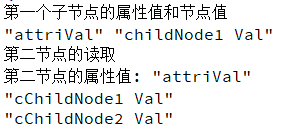
summary
XML Files use QDomDocument When writing and reading objects, you need to pay attention to the following , Add when needed QDomText Object settings ; When reading, you need to read its first child node , And get the value .( The more complex the file structure , More complex code is needed to read and write )
Related articles
Qt write in Json file ( Including source code + notes )
Qt read Json file ( Including source code + notes )
Qt Reading and writing ini file ( Including source code + notes )
Friendship tips —— Where can't you understand? It's private , Let's make progress together
( It's not easy to create , Please leave a free praise thank you ^o^/)
notes : This paper summarizes the problems encountered by the author in the process of programming , The content is for reference only , If there are any mistakes, please point out .
notes : If there is any infringement , Please contact the author for deletion
版权声明
本文为[Lao Wang who loves cooking]所创,转载请带上原文链接,感谢
https://yzsam.com/2022/04/202204231800591059.html
边栏推荐
- Crawl the product data of Xiaomi Youpin app
- C language implements memcpy, memset, strcpy, strncpy, StrCmp, strncmp and strlen
- Docker 安装 MySQL
- Classification of cifar100 data set based on convolutional neural network
- Solving the problem of displaying too many unique values in ArcGIS partition statistics failed
- What are the relationships and differences between threads and processes
- Implementation of object detection case based on SSD
- Eigen learning summary
- Rust: shared variable in thread pool
- C medium? This form of
猜你喜欢





![Yolov4 pruning [with code]](/img/09/ea4376d52edb7e419ace2cb1e0356b.gif)
随机推荐
Robocode tutorial 5 - enemy class
Rust: how to match a string?
Arcpy adds fields and loop assignments to vector data
Reptile efficiency improvement method
Installation du docker redis
Operators in C language
Stanford machine learning course summary
Crawling mobile game website game details and comments (MQ + multithreading)
Install pyshp Library
C language implements memcpy, memset, strcpy, strncpy, StrCmp, strncmp and strlen
cartographer_ There is no problem compiling node, but running the bug that hangs directly
re正则表达式
Secure credit
Robocode tutorial 3 - Robo machine analysis
Dock installation redis
ROS package NMEA_ navsat_ Driver reads GPS and Beidou Positioning Information Notes
Docker 安装 Redis
深度学习经典网络解析目标检测篇(一):R-CNN
Implementation of k8s redis one master multi slave dynamic capacity expansion
ArcGIS license error -15 solution