PyTorch implementation of the supervised learning experiments from the paper Model-Agnostic Meta-Learning (MAML)

Overview

pytorch-maml

This is a PyTorch implementation of the supervised learning experiments from the paper Model-Agnostic Meta-Learning (MAML): https://arxiv.org/abs/1703.03400

Important: You will need the latest version of PyTorch, v.0.2.0 to run this code (otherwise you will get errors about double backwards not being supported).

Currently, only the Omniglot experiments have been replicated here. The hyper-parameters are the same as those used in the original Tensorflow implementation, except that only 1 random seed is used here.

5-way 1-shot training, best performance 98.9%
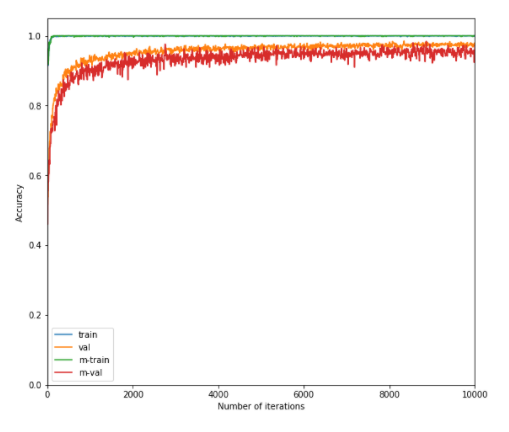
Alt text

20-way 1-shot training, best performance 92%
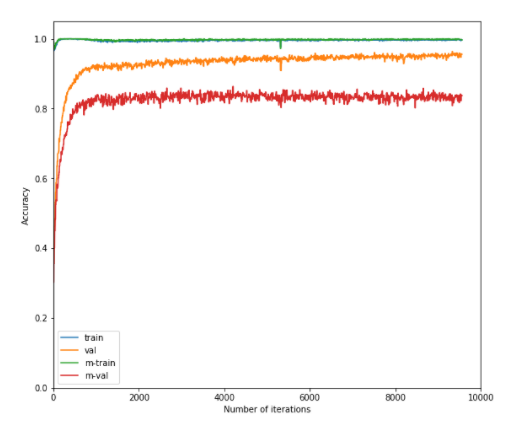
Alt text

Note: the 20-way performance is slightly lower than that reported in the paper (they report 95.8%). If you can see why this might be, please let me know. Also in this experiment, we can see evidence of overfitting to the meta-training set.

The 5-way results are achieved by simply meta-testing the network trained on the 1-shot task on the 5-shot task (e.g. for the 5-way 5-shot result, test the 5-way 1-shot trained network with 5-shots). Again the 20-way result is lower here than reported in the paper.

This repo also contains code for running maml experiments on permuted MNIST (tasks are created by shuffling the labels). This is a nice sanity check task.

license

This software is distributed under the MIT license.

to-do

  • port to pytorch 0.4 from 0.2 and python 3 from 2
  • investigate performance difference from TF version
  • add first-order version
Owner
Kate Rakelly
PhD in machine learning at UC Berkeley AI Research Lab (BAIR), advised by Sergey Levine. I work on reinforcement learning, meta-learning, and robotics.
Kate Rakelly
Reproduce ResNet-v2(Identity Mappings in Deep Residual Networks) with MXNet

Reproduce ResNet-v2 using MXNet Requirements Install MXNet on a machine with CUDA GPU, and it's better also installed with cuDNN v5 Please fix the ran

Wei Wu 531 Dec 04, 2022
[TPAMI 2021] iOD: Incremental Object Detection via Meta-Learning

Incremental Object Detection via Meta-Learning To appear in an upcoming issue of the IEEE Transactions on Pattern Analysis and Machine Intelligence (T

Joseph K J 66 Jan 04, 2023
Learning to Adapt Structured Output Space for Semantic Segmentation, CVPR 2018 (spotlight)

Learning to Adapt Structured Output Space for Semantic Segmentation Pytorch implementation of our method for adapting semantic segmentation from the s

Yi-Hsuan Tsai 782 Dec 30, 2022
Differentiable Neural Computers, Sparse Access Memory and Sparse Differentiable Neural Computers, for Pytorch

Differentiable Neural Computers and family, for Pytorch Includes: Differentiable Neural Computers (DNC) Sparse Access Memory (SAM) Sparse Differentiab

ixaxaar 302 Dec 14, 2022
the official code for ICRA 2021 Paper: "Multimodal Scale Consistency and Awareness for Monocular Self-Supervised Depth Estimation"

G2S This is the official code for ICRA 2021 Paper: Multimodal Scale Consistency and Awareness for Monocular Self-Supervised Depth Estimation by Hemang

NeurAI 4 Jul 27, 2022
In this project we predict the forest cover type using the cartographic variables in the training/test datasets.

Kaggle Competition: Forest Cover Type Prediction In this project we predict the forest cover type (the predominant kind of tree cover) using the carto

Marianne Joy Leano 1 Mar 15, 2022
Code for the CVPR 2021 paper "Triple-cooperative Video Shadow Detection"

Triple-cooperative Video Shadow Detection Code and dataset for the CVPR 2021 paper "Triple-cooperative Video Shadow Detection"[arXiv link] [official l

Zhihao Chen 24 Oct 04, 2022
Pytorch implementation of "Get To The Point: Summarization with Pointer-Generator Networks"

About this repository This repo contains an Pytorch implementation for the ACL 2017 paper Get To The Point: Summarization with Pointer-Generator Netwo

wxDai 7 Oct 14, 2022
CyTran: Cycle-Consistent Transformers for Non-Contrast to Contrast CT Translation

CyTran: Cycle-Consistent Transformers for Non-Contrast to Contrast CT Translation We propose a novel approach to translate unpaired contrast computed

Nicolae Catalin Ristea 13 Jan 02, 2023
Automated Melanoma Recognition in Dermoscopy Images via Very Deep Residual Networks

Introduction This repository contains the modified caffe library and network architectures for our paper "Automated Melanoma Recognition in Dermoscopy

Lequan Yu 47 Nov 24, 2022
Animate molecular orbital transitions using Psi4 and Blender

Molecular Orbital Transitions (MOT) Animate molecular orbital transitions using Psi4 and Blender Author: Maximilian Paradiz Dominguez, University of A

3 Feb 01, 2022
Stock-history-display - something like a easy yearly review for your stock performance

Stock History Display Available on Heroku: https://stock-history-display.herokua

LiaoJJ 1 Jan 07, 2022
Code for the Convolutional Vision Transformer (ConViT)

ConViT : Vision Transformers with Convolutional Inductive Biases This repository contains PyTorch code for ConViT. It builds on code from the Data-Eff

Facebook Research 418 Jan 06, 2023
Official code for 'Pixel-wise Energy-biased Abstention Learning for Anomaly Segmentationon Complex Urban Driving Scenes'

PEBAL This repo contains the Pytorch implementation of our paper: Pixel-wise Energy-biased Abstention Learning for Anomaly Segmentationon Complex Urba

Yu Tian 115 Dec 29, 2022
DeepVoxels is an object-specific, persistent 3D feature embedding.

DeepVoxels is an object-specific, persistent 3D feature embedding. It is found by globally optimizing over all available 2D observations of

Vincent Sitzmann 196 Dec 25, 2022
LERP : Label-dependent and event-guided interpretable disease risk prediction using EHRs

LERP : Label-dependent and event-guided interpretable disease risk prediction using EHRs This is the code for the LERP. Dataset The dataset used is MI

5 Jun 18, 2022
A method that utilized Generative Adversarial Network (GAN) to interpret the black-box deep image classifier models by PyTorch.

A method that utilized Generative Adversarial Network (GAN) to interpret the black-box deep image classifier models by PyTorch.

Yunxia Zhao 3 Dec 29, 2022
Code for "Modeling Indirect Illumination for Inverse Rendering", CVPR 2022

Modeling Indirect Illumination for Inverse Rendering Project Page | Paper | Data Preparation Set up the python environment conda create -n invrender p

ZJU3DV 116 Jan 03, 2023
Planar Prior Assisted PatchMatch Multi-View Stereo

ACMP [News] The code for ACMH is released!!! [News] The code for ACMM is released!!! About This repository contains the code for the paper Planar Prio

Qingshan Xu 127 Dec 31, 2022
Python Jupyter kernel using Poetry for reproducible notebooks

Poetry Kernel Use per-directory Poetry environments to run Jupyter kernels. No need to install a Jupyter kernel per Python virtual environment! The id

Pathbird 204 Jan 04, 2023