Multi agent DDPG algorithm written in Python + Pytorch

Overview

Project 3: Collaboration and Competition

Project Details

For this project, you will work with the Tennis environment.

Trained Agent

In this environment, two agents control rackets to bounce a ball over a net. If an agent hits the ball over the net, it receives a reward of +0.1. If an agent lets a ball hit the ground or hits the ball out of bounds, it receives a reward of -0.01. Thus, the goal of each agent is to keep the ball in play.

The observation space consists of 8 variables corresponding to the position and velocity of the ball and racket. Each agent receives its own, local observation. Two continuous actions are available, corresponding to movement toward (or away from) the net, and jumping.

The task is episodic, and in order to solve the environment, your agents must get an average score of +0.5 (over 100 consecutive episodes, after taking the maximum over both agents). Specifically,

  • After each episode, we add up the rewards that each agent received (without discounting), to get a score for each agent. This yields 2 (potentially different) scores. We then take the maximum of these 2 scores.
  • This yields a single score for each episode.

The environment is considered solved, when the average (over 100 episodes) of those scores is at least +0.5.

Getting Started

Dependencies

To set up your python environment to run the code in the notebook, follow the instructions below.

  1. Create (and activate) a new environment with Python 3.6.

    • Linux or Mac:
    conda create --name drlnd python=3.6
    source activate drlnd
    • Windows:
    conda create --name drlnd python=3.6 
    activate drlnd
  2. Clone the repository, and navigate to the python/ folder. Then, install several dependencies.

git clone https://github.com/udacity/deep-reinforcement-learning.git
cd deep-reinforcement-learning/python
pip install .

Note: You may encounter issues with installing Pytorch 0.4.0. In that case, please replace the file python/requirements.txt with the file requirements.txt inside this project.

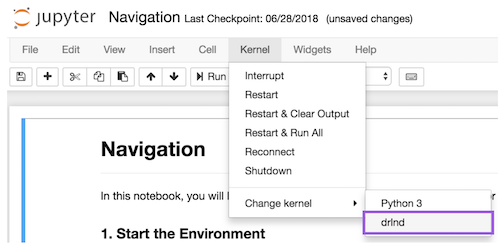
  1. Create an IPython kernel for the drlnd environment.
python -m ipykernel install --user --name drlnd --display-name "drlnd"
  1. Before running code in a notebook, change the kernel to match the drlnd environment by using the drop-down Kernel menu.

Kernel

Instructions

  1. Download the environment from one of the links below. You need only select the environment that matches your operating system:

    (For Windows users) Check out this link if you need help with determining if your computer is running a 32-bit version or 64-bit version of the Windows operating system.

    (For AWS) If you'd like to train the agent on AWS (and have not enabled a virtual screen), then please use this link to obtain the "headless" version of the environment. You will not be able to watch the agent without enabling a virtual screen, but you will be able to train the agent. (To watch the agent, you should follow the instructions to enable a virtual screen, and then download the environment for the Linux operating system above.)

  2. Place the extracted files in the same folder as the notebook Tennis.ipynb.

  3. Load the notebook with Jupyter notebook. (The command to start Jupyter notebook is jupyter notebook)

  4. Follow further instructions in the notebook.

You might also like...
Implementation of EMNLP 2017 Paper
Implementation of EMNLP 2017 Paper "Natural Language Does Not Emerge 'Naturally' in Multi-Agent Dialog" using PyTorch and ParlAI

Language Emergence in Multi Agent Dialog Code for the Paper Natural Language Does Not Emerge 'Naturally' in Multi-Agent Dialog Satwik Kottur, José M.

Implementation of EMNLP 2017 Paper
Implementation of EMNLP 2017 Paper "Natural Language Does Not Emerge 'Naturally' in Multi-Agent Dialog" using PyTorch and ParlAI

Language Emergence in Multi Agent Dialog Code for the Paper Natural Language Does Not Emerge 'Naturally' in Multi-Agent Dialog Satwik Kottur, José M.

Pytorch modules for paralel models with same architecture. Ideal for multi agent-based systems

WideLinears Pytorch parallel Neural Networks A package of pytorch modules for fast paralellization of separate deep neural networks. Ideal for agent-b

A lightweight Python-based 3D network multi-agent simulator. Uses a cell-based congestion model. Calculates risk, loudness and battery capacities of the agents. Suitable for 3D network optimization tasks.

AMAZ3DSim AMAZ3DSim is a lightweight python-based 3D network multi-agent simulator. It uses a cell-based congestion model. It calculates risk, battery

Spatial Intention Maps for Multi-Agent Mobile Manipulation (ICRA 2021)

spatial-intention-maps This code release accompanies the following paper: Spatial Intention Maps for Multi-Agent Mobile Manipulation Jimmy Wu, Xingyua

Rethinking the Importance of Implementation Tricks in Multi-Agent Reinforcement Learning

RIIT Our open-source code for RIIT: Rethinking the Importance of Implementation Tricks in Multi-AgentReinforcement Learning. We implement and standard

Official source code to CVPR'20 paper,
Official source code to CVPR'20 paper, "When2com: Multi-Agent Perception via Communication Graph Grouping"

When2com: Multi-Agent Perception via Communication Graph Grouping This is the PyTorch implementation of our paper: When2com: Multi-Agent Perception vi

Multi Agent Path Finding Algorithms

MATP-solver Simulator collision check path step random initial states or given states Traditional method Seperate A* algorithem Confict-based Search S

A parallel framework for population-based multi-agent reinforcement learning.

MALib: A parallel framework for population-based multi-agent reinforcement learning MALib is a parallel framework of population-based learning nested

Releases(v1.0.0)
Owner
Rogier Wachters
Rogier Wachters
Towards the D-Optimal Online Experiment Design for Recommender Selection (KDD 2021)

Towards the D-Optimal Online Experiment Design for Recommender Selection (KDD 2021) Contact 0 Jan 11, 2022

Topic Modelling for Humans

gensim – Topic Modelling in Python Gensim is a Python library for topic modelling, document indexing and similarity retrieval with large corpora. Targ

RARE Technologies 13.8k Jan 03, 2023
Scalable, event-driven, deep-learning-friendly backtesting library

...Minimizing the mean square error on future experience. - Richard S. Sutton BTGym Scalable event-driven RL-friendly backtesting library. Build on

Andrew 922 Dec 27, 2022
This is the solution for 2nd rank in Kaggle competition: Feedback Prize - Evaluating Student Writing.

Feedback Prize - Evaluating Student Writing This is the solution for 2nd rank in Kaggle competition: Feedback Prize - Evaluating Student Writing. The

Udbhav Bamba 41 Dec 14, 2022
A diff tool for language models

LMdiff Qualitative comparison of large language models. Demo & Paper: http://lmdiff.net LMdiff is a MIT-IBM Watson AI Lab collaboration between: Hendr

Hendrik Strobelt 27 Dec 29, 2022
Code for Referring Image Segmentation via Cross-Modal Progressive Comprehension, CVPR2020.

CMPC-Refseg Code of our CVPR 2020 paper Referring Image Segmentation via Cross-Modal Progressive Comprehension. Shaofei Huang*, Tianrui Hui*, Si Liu,

spyflying 55 Dec 01, 2022
ExCon: Explanation-driven Supervised Contrastive Learning

ExCon: Explanation-driven Supervised Contrastive Learning Link to the paper: https://arxiv.org/pdf/2111.14271.pdf Contributors of this repo: Zhibo Zha

Zhibo (Darren) Zhang 18 Nov 01, 2022
MAGMA - a GPT-style multimodal model that can understand any combination of images and language

MAGMA -- Multimodal Augmentation of Generative Models through Adapter-based Finetuning Authors repo (alphabetical) Constantin (CoEich), Mayukh (Mayukh

Aleph Alpha GmbH 331 Jan 03, 2023
A collection of metrics for evaluating timbre dissimilarity using the TorchMetrics API

Timbre Dissimilarity Metrics A collection of metrics for evaluating timbre dissimilarity using the TorchMetrics API Installation pip install -e . Usag

Ben Hayes 21 Jan 05, 2022
K-PLUG: Knowledge-injected Pre-trained Language Model for Natural Language Understanding and Generation in E-Commerce (EMNLP Founding 2021)

Introduction K-PLUG: Knowledge-injected Pre-trained Language Model for Natural Language Understanding and Generation in E-Commerce. Installation PyTor

Xu Song 21 Nov 16, 2022
Evolutionary Scale Modeling (esm): Pretrained language models for proteins

Evolutionary Scale Modeling This repository contains code and pre-trained weights for Transformer protein language models from Facebook AI Research, i

Meta Research 1.6k Jan 09, 2023
A curated list of awesome resources related to Semantic Search🔎 and Semantic Similarity tasks.

A curated list of awesome resources related to Semantic Search🔎 and Semantic Similarity tasks.

224 Jan 04, 2023
A PyTorch-based open-source framework that provides methods for improving the weakly annotated data and allows researchers to efficiently develop and compare their own methods.

Knodle (Knowledge-supervised Deep Learning Framework) - a new framework for weak supervision with neural networks. It provides a modularization for se

93 Nov 06, 2022
A framework for using LSTMs to detect anomalies in multivariate time series data. Includes spacecraft anomaly data and experiments from the Mars Science Laboratory and SMAP missions.

Telemanom (v2.0) v2.0 updates: Vectorized operations via numpy Object-oriented restructure, improved organization Merge branches into single branch fo

Kyle Hundman 844 Dec 28, 2022
Framework for evaluating ANNS algorithms on billion scale datasets.

Billion-Scale ANN http://big-ann-benchmarks.com/ Install The only prerequisite is Python (tested with 3.6) and Docker. Works with newer versions of Py

Harsha Vardhan Simhadri 132 Dec 24, 2022
This code provides a PyTorch implementation for OTTER (Optimal Transport distillation for Efficient zero-shot Recognition), as described in the paper.

Data Efficient Language-Supervised Zero-Shot Recognition with Optimal Transport Distillation This repository contains PyTorch evaluation code, trainin

Meta Research 45 Dec 20, 2022
这是一个deeplabv3-plus-pytorch的源码,可以用于训练自己的模型。

DeepLabv3+:Encoder-Decoder with Atrous Separable Convolution语义分割模型在Pytorch当中的实现 目录 性能情况 Performance 所需环境 Environment 注意事项 Attention 文件下载 Download 训练步骤

Bubbliiiing 350 Dec 28, 2022
Open source Python implementation of the HDR+ photography pipeline

hdrplus-python Open source Python implementation of the HDR+ photography pipeline, originally developped by Google and presented in a 2016 article. Th

77 Jan 05, 2023
Automatically measure the facial Width-To-Height ratio and get facial analysis results provided by Microsoft Azure

fwhr-calc-website This project is to automatically measure the facial Width-To-Height ratio and get facial analysis results provided by Microsoft Azur

SoohyunPark 1 Feb 07, 2022
PyTorch implementation of MICCAI 2018 paper "Liver Lesion Detection from Weakly-labeled Multi-phase CT Volumes with a Grouped Single Shot MultiBox Detector"

Grouped SSD (GSSD) for liver lesion detection from multi-phase CT Note: the MICCAI 2018 paper only covers the multi-phase lesion detection part of thi

Sang-gil Lee 36 Oct 12, 2022